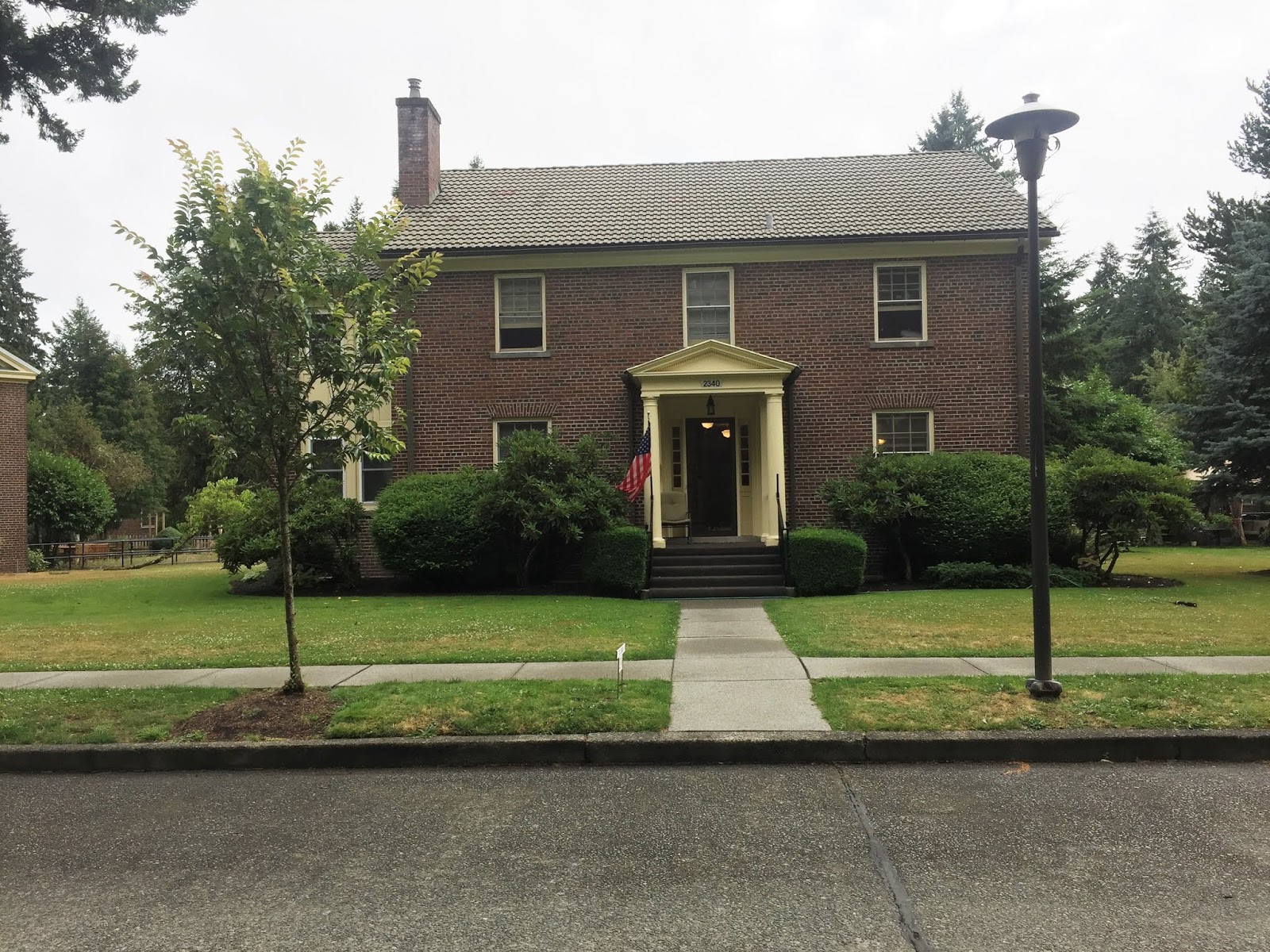
We pulled out of the parking pad of 2639 Hillcrest Road at 0930 hrs. on Monday, December 28, 2020. The destination today was the La Quinta Inn, Stockton, CA. We have divided the trip to Ajo into three legs: one with a night in Stockton, one with a night with Connie, in Long Beach, and with the end of the third day’s drive finding us at Dave and Joy’s winter home, in Why, AZ.
Upon our return from Ajo this last spring, we put the Horizon RV on the market. It was a 2004 model. Overall, it still performed very well. But it was beginning to incur age-related maintenance issues. We have enjoyed many years of wonderful adventures in the Horizon since we bought it in 2013. What we would do for vacation travel instead. Well, this year it is going to be in the 2018 GMC Canyon pickup.
We have just enjoyed a wonderful
Christmas. We got to celebrate the day with Chris, his girlfriend, Michelle,
with Liam, and with Tucker. Chef Anne hosted the day’s beginning with a
wonderful breakfast. As has been the family tradition, the opening of gifts was
to wait until everyone had finished the meal and the table had been cleared.
Finally, we had all eaten. We
collected in the living room. Chris and the boys had brought a couple of
baskets of gifts from their home. The collection of gaily wrapped packages
amassed a significant heap, on top of, and around the coffee table.
Chris presented gifts to each of us.
We had the opportunity to watch what had been gifted as it was opened by the
recipient. It happened once again, without fail, the presents were considerate,
appropriate, and well-received. Everyone enjoyed what they had received. There
were grins on everyone’s faces as they watched the recipients of the gifts that
had been chosen for them respond when the gift was opened. This had been a
magic morning.
We had finished gift-giving, and we
were admiring what we had received, as well as collecting the mountain of
wrapping papers. The doorbell rang. Jim, Paula, Mark, and Angie had just arrived
for a Christmas visit. It has been a neighbor tradition, begun several decades
ago, that the Duncan’s and Leroy’s exchange gifts.
Mark and Angie were towing a trailer
that was carrying a nice-looking golf cart. I heard someone say that the cart
and trailer were gifts to Jim. He is a weekly golfer. I congratulated Jim.
Which he accepted.

But no. The trailer and cart were meant for me. I was bowled over. Chris and Anne had gotten together to buy these two gifts for me. I was planning to carry my motorbike with us to Ajo. I would use the bike to commute to and from the woodshop. That would leave Anne free, with the pickup. Apparently, neither of them felt good about me putting around Ajo on my motorized mountain bike.
The cart is a Club Car. It is a 48-volt electric rig of the late 90’s vintage. It can comfortably seat four belted passengers. The cart is in excellent condition, except for the six, 8-volt batteries. Chris was told by the seller, that it needed new batteries.
The day after Christmas I shopped
Medford and located a store that had the deep cycle batteries needed for the
cart. I bought them and I installed them. The cart was ready for its tow to the
Southwest. This would be fun.
Monday’s drive to Stockton was
uneventful. The anxious beginning of our journey to the south is always
centered on what the weather is like at the Siskiyou Pass, on I-5. On I-5, this
section of mountainous freeway, 30 miles south of Medford, has the highest
elevation of road between Mexico and Canada. If snow chains were required, we
would need to drive around the mountains, to the west. It dawned a bright, but
crisp, sunny day. There had been no new snow on the pass.
It was icky as we approached Sacramento,
CA from the north. The number of lanes on the freeway increased, and traffic
traveling in the near end-of-day rush hour seemed to come out of nowhere. Avoiding
the far right-hand lane, with its merging entry traffic, we swooped with the
masses past the many freeway splits and around the curves taking us to south
Sacrament.
I was thankful that we were not
piloting the 40-foot-long Horizon RV while towing another 15 feet of a passenger
car. Those rides along the dense city sections of the freeway were harrowing. In
a short time, the highway lanes once again became two. Fifty miles south of
Sacramento, we came to Exit 476, the portal to our first night’s stay.
I had chosen La Quinta Motor Hotel
because the ones I had seen seemed first-class, yet affordable. Anne informed
me that this motel chain, along with a few other national names, were privately
owned sites. Given that status, they did not answer, in total, to a franchise’s
high standard. This particular motel had large freeway display signage, but it
had no street-level marquee. After driving past the entrance, a couple of
times, I left the directions to the “dash bitch”, our GPS, to point the way.
We were not camping at a 5, or even at
a 4-star motel. But the room was clean, and we were tired. Soon it was time to arrange
some dinner.
The dinner venue was going to be a drive-thru.
We settled on Taco Bell. Anne would have a Taco Salad, and I would have a
Burrito Supreme. With Bat Phone in hand, I asked Siri how to drive to the
closest Taco Bell. It was over the freeway, and a couple of blocks further, on
the left. We would soon learn that it was best not to plan on eating take-out
at dinner time. This was similar to driving on California freeways during rush
hour. The meals were secured, and we ate. After a bit of TV, we hit the sack.
Tuesday morning, we left early. We
hadn’t seen nightmare traffic yet; we are heading toward Los Angeles. The
truck’s GPS alerts seemed non-stop. It warned us to “merge left”, or “merge
right” at an upcoming freeway intersection. The once familiar two-lane I-5
freeway became four lanes, then six, and up to eight lanes of a bending and
heaving 65 mph ribbon of offensive chaos.
It doesn’t seem possible that one
could drive at those speeds for over an hour and still not have crossed from
one edge of a metropolis to another. And I supposed this wasn’t the case this
morning. I don’t know. But I presume we crossed the boundaries of half a dozen
or more cities as I navigated past LA.
We were eventually shuttled from I-5 South onto
I-405. This was going to feed us closer to the urban scene we were looking for
in Long Beach. One of Anne’s summer tennis mates, and our good friend, Connie,
has a winter home in Long Beach. We are invited to visit and spend a night with
her.
Tall date palms lined the median strips. Their long
frons twisted and stirred quietly against the blue-sky backdrop. The traffic
was gentle, and it became sparse as we approached Connie’s home on Stevely Avenue.
We pulled onto her driveway, parked, and with stiff legs we slowly extracted
ourselves from the confines of the cab.
Connie had heard the arrival commotion. She
greeted us with warm hugs and with her normal air of high-energy exuberance. Connie
showed us into her home. She introduced us to her “foster” dog, Marshmallow.
Marshmallow is a mixed breed animal. He is a predominantly
lethargic Pitbull. During her winter stay’s in Long Beach, Connie offers her
love, and her home to shelter dogs. The animal shelter provides food for the
pet, and it advertises the animal for adoption. Connie shared two concerns with
us; one is that she has seen no advertising. The second is that the aged Marshmallow
will be handed over to the shelter’s termination squad when Connie returns to
Medford in late spring. We all agree that Marshmallow would be an excellent companion
for a home-bound person. Naturally, I suggested that Connie use Craigslist.
Connie
is an aggressive hostess. That is meant in a good way. She goes out of her way
to ensure that you are comfortable, well-fed and entertained. The evening’s
dinner menu had been settled. What was to occupy our evening hours was nutted
out. We were ready to sit down and play some cards.
Anne has fostered a close-knit group of women
who share at least two of her fondness’s; tennis, and pinochle. Once a week there
is tennis at the country club. And, once a week, one of the ladies is the hostess
for an afternoon of cards and happy visiting. So, while time waits for dinner
and evening activity, we play some three-handed pinochle. Nearby, Marshmallow watches.
His massive chest blends into an arched back, and he stands there.

Following dinner, Connie’s friend, Karen, came to the house. After introductions, Connie, Karen, and Anne drove to Naples. A part of suburban Naples affronts the bay. The homes on the bay are of the mansion variety. A Christmas time activity is to walk the bay-front sidewalks and marvel at the lighted home fronts.
While the three ladies enjoyed their walk-about at the shores of Naples, I showered and got into a change of clothes. They returned soon. They were excited about the beauty of the lighted scenes they had shared. Anne showed me a couple of photographs. The lights were dazzling.
After exchanging comments about the Naples
visit, we sat around the dining table for a couple of games of Rummikub. The
rules are simple. Each player selects 14 numbered tiles and places them on a
rack. On the first turn, each player tries to make a set of one or more groups or
runs that adds up to at least 30 points.
A group is formed when three or four tiles of the
same numbers are put together. Each number will have one of four different
colors. A run is formed when three or more numbers of the same color are played
together. The run numbers must be sequential.
Once a player has qualified with a 30-point
play, the player may, on subsequent turns, make new groups or runs, or add to
other player’s plays. If one can not play, then a chip is drawn from the pool.
The new chip can’t be used until the next turn. From this point on, it is each player’s responsibility
to scope out places where tiles can be added to a run or a group. The first
player to use all of their tiles is the winner.
Rummikub can become very intense. With several
players, there becomes a large number of runs and groups to look at when it is
your turn. A preplanned move gets spoiled by the player before you. We enjoyed a
couple of matches. I was lucky enough to have won at least one round.
The evening was over. Karen said goodbye. Connie
presented plans for tomorrow’s breakfast and we all went to bed.
When Connie is living at her Medford home, she
rents the Long Beach house to a lady acquaintance. That woman uses the bedroom Anne,
and I are sleeping in. I mention this because the woman has scoliosis. This is
a lateral curvature of the spine. The short version is, she has a thick, soft
foam pad on the bed. We discovered that once a position was fixed on this bed,
there was near zero freedom of movement. Once comfortable, I fell asleep.
Wednesday morning, Connie prepared oatmeal for
breakfast. She had a tennis engagement this morning, so we needed to eat, and
then pack up for the final leg to Ajo.
We hugged goodbyes and we were on the road by
0830 hrs. The plan was to follow whatever route the GPS directed, to get us to
Blythe, CA, via I-10E. It took a little over an hour of city driving before we
intercepted our eastbound freeway. We have traveled this path many times over
the last few years. Finally getting away from the dense urban area, that is
coastal, southern California was a relief. And we trucked on.
This final leg of our journey passed smoothly. We pulled into the large front yard of Dave and Joy’s by mid-afternoon. Although they live in the community called Why their 104 East Guinn Road address is served by the Ajo post office. Ajo has the closest postal service. Why has its own zip code.
We were invited to stay the night with Dave and Joy. The cottage we rented from Daniel wasn’t available for check-in until Thursday, New Year’s Eve. While Anne and Joy visited, Dave introduced me to all the remodel improvements they have made since we left them last year. They are completely moved into their new winter home. The final, major task in the home’s remodel is to finish the construction of the en suite master bathroom.
Thursday morning, we drove to Ajo, where we met
Daniel, and his wife, at 575 Guest House Road. This will be our winter digs. Daniel’s
folks had lived in the home until their passing. Like so many homesites in this
area, the two-bedroom house sits on a deep, minimally improved lot.

The second bedroom has no bed. It is used as a
craft room. This will be perfect for Anne. The room comes with a sewing machine
table. Fortunately, the home comes with towels, linens, and ample kitchen
wares. We had brought several kitchen tools, just in case.
The kitchen window looks out to the backyard.
On your eye’s trip to the wire fence, it passes through the home’s attached Casita.
The Casita is an ell-shaped structure that wraps around the end of the cottage.
Widely spaced stud framing has a flyscreen attached. The enclosed area has a
cemented floor. A large table, with four chairs, sits in the corner of the shaded
get-away space.
At the back, left corner of the yard is a
garage. This is a space for some odds and ends that Daniel has yet to part
with. Inside the man-door of the garage is a power outlet. I plugged the golf
cart’s charging transformer into the outlet. This will be convenient for
frequent needs.
On New Year’s Eve, we returned to Why to share
the closing day of 2020 with Dave and Joy. We were greeted, at the home, by Tom and
Tereasa. They are good friends of Dave and Joy. The six of us will share the
dinner and the evening.
Dave,
Tom, and I visited in the living room. The ladies visited in the kitchen. They
shared tasks in the preparation of the evening meal.
I enjoyed learning about Tom’s background. He
worked as a nurse. He is also a private pilot. He told us about the specialized
metal machining work that his son, Bill, does to make championship-level target
rifles. I was most impressed with the level of specialized knowledge that Tom
had regarding both aircraft and rifles.
We all shared a good dinner time conversation.
Tom and Tereasa were not into table games. So, we yabbed for a while after
dinner, as well. It was around 2130 hrs. when the couple said goodnight to Dave
and Joy. Anne and I wished Dave and Joy a Happy New Year when we left a half-hour
later.
The police were out in force tonight. On the
way back to Ajo, we spotted two sheriff cars parked at pull-outs alongside the
highway. Anne was very careful about watching the speed limits. We arrived
safely home after the 10-mile trip.
No.
We didn’t stay up to watch the Time’s Square ball drop at midnight. We were
both feeling a bit stretched. We hit the sack early.
The pickup had been loaded. I brought two
containers filled with tools that I would use in the woodshop. New Year’s Day,
I loaded the containers onto the back deck of the golf cart. I drove to the
woodshop. There, I toted the storage bins into the shop’s storage room. I used
two lockers to hold what I had brought to Ajo. I re-familiarized myself with
the shop and the machinery. I was pleased to see the area tidy and to be much
the way I had left it last Spring.
This evening, we were once again asked to join
Dave and Joy for dinner. We were asked, also, to bring along our pinochle
cards. As the sun began to set behind the mountains to the west, Dave and I
created a small project. Dave wants to put a couple of socketed ceiling lights
above the walkway to the side patio. He keeps the barbeque on the side of this
covered sidewalk. Two lights, one on each side of the centerline of the
barbeque will make nighttime cooking much easier.
We planned to remove the light that is above
the door from the Arizona room. That old light’s wire box will be the new circuit’s
starting place. The two of us got a new Romex wire connected to the outlet box.
This set of wires ran to the first ceiling light location.
We finished as the bell rang for dinner. Cleaned up, we sat down for a welcomed meal. After the dishes had been cleared from the table, and Dave and I had refreshed our wine glasses, we brought out the pinochle cards. It was going to be the guys against the gals.

Dave has damaged vision. It is bad enough that
he is unable to drive. Corrective surgery is planned for later this spring. The
upshot, however, is that for the card game to move forward, we needed to call
out what cards had been led, and what had followed. Dave used a machinist’s eye
goggles to keep track of the cards in his hand. The goggles had strong magnifying
lenses. They also came with bright LEDs. Dave used the lights to illuminate his
cards.
The pinochle game was a good one. It lasted a
long time. The game came to no winning conclusion. It was called a draw. This
had been a busy, fun day. We said our goodnights and left.
After breakfast, Monday morning, I drove the
Club Car to the woodshop. I was the first to arrive. I set some tools near the
lathe. I had a small piece of a green limb that I was going to turn into a
toothpick cup. As I was turning, Shandell came into the shop. She quickly
gathered from her locker the table project she had begun last year.
Jason was the next to arrive. He carried in several
pieces of oak that he had lumbered from a tree on his property. His project for
today was to make a closet for the rubbish container.
A man, new to the shop, came in with a copy of
the shop’s waiver form filled out. He had been told to ask for me. I would get
him signed up. His name is Ken. Ken gave me a $50 bill, for a three-month
registration. His pre-retirement work had been in a cabinet shop.
Michael came to the shop later. Michael makes,
and sells boxes. He showed me one he was currently building. Michael is the
craftsman with the longest tenure at the woodshop. His main yeartime digs are
in Albuquerque. Michael is also the primary socializer at the shop.
Jay rolled up in his converted U-Haul truck. He has spent a couple of years adapting the delivery truck into his permanent residence. Jay is a steadfast worker and is forever in search of ways to improve conditions in the shop. His most recent inspiration was to purchase a new rail guide system for the table saw. Jay brought it to my attention that the saw’s fence did not stay accurately placed, once set. No one else had noticed this malady if it exists.
Early in the afternoon, Steve drove to the front door in his golf cart. Steve does not do woodwork in the shop. However, he visits most days. He has asked for assistance on some personal projects, and the shop is always rewarded with his thanks. The shop operates using older equipment, that is maintained by the attendees. Steve heard that we needed a properly functioning finish sander, so he bought one. The shop has a router table with a router and a few blades. Steve purchased a Bosch finishing router. He bought with it a large set of blades.
Steve brought a can of white spray paint. Some
years ago, high on the wall near the entry door, a sign was painted. In large
black letters are the words, “Drug Free Zone”. Perhaps, at some time a shop
steward had felt the building required this proclamation. Steve found the large
display offensive. The nonuse of drugs in such a facility went without
question.
Steve solicited Jason and me to set the shop
ladder against the wall. Jason was volunteered to climb up and to dust and
paint over the lettering. More paint was needed, but the entry presentation of
the shop was already improved.
Steve had tried to remove painted floor words
that say, “No Entry”. These words were printed on each side of the first worktable,
as one comes into the shop. He used his hand drill that he had loaded with a
wire wheel. The wire wheel was declared a bad approach. It didn’t provide
enough agitation to lift the paint.
Later in the day, Steve returned with a spray
bottle of paint remover. He and Jay gave the floor a shot. They waited a few
minutes, and then Jay scraped at the trial spot. Not much changed. It was soon
declared that the solution was going to be to paint over these two sections of
the cement floor. This would be left for later discussion.

Joy asked me to turn her a couple more shot glasses, like one I had given her some time ago. The wooden glass is about 3” tall, and it has a wine glass shape. The bowl of the glass holds a little more than an ounce of liquid. It is meant to be used as a whiskey sipping glass.
I had brought with me several short pieces of 2x2 hickory. I cut a few short lengths from this stock to use for new shot glasses. I turned one glass, and I was setting up to turn a second one. A man came in and he was anxiously waiting for me to be finished with the lathe. I cleared my stuff away, and I turned the lathe over to him.
His name is John. John is a new steward at the
shop. He arrived after Anne and I had left last year. John made some repairs to
the lathe. Today, he wanted to oil a couple of parts. After he reassembled the lathe
head, John left.
I will formally meet John tomorrow. It is his
scheduled day to be a shop steward. I reloaded my lathe stock. It took about an
hour to finish making four new shot glasses. I finished the pieces with a
coating of Tung Oil.
The shop signed up two new crafters today. A
man and a woman. Both were eager to get stuck into making something. The woman,
Jennifer, was helped by Michael with the construction of a small box. She used
pieces of mesquite that I had left on a bench shelf last year. They were both
shown the proper use of the chop saw, as well as how to use the table saw.
I worked with the man, Patrick, with the design
and the piecing together of a box to hold his new sharpening stone. The work
involved cutting 45 degree ends on pieces of the frame, that he had ripped on
the table saw. He then basically built a picture frame around the sharpening
stone. The stone was centered on a piece of 1”x6” pine. Patrick then made a lid
to fit over and protect the stone. Patrick’s work was set aside for the glue to
dry. Tomorrow he will do some sanding to complete his box.
This afternoon, Steve motored to the front door
in his electric golf cart. He had with him the owner, publisher of Ajo Copper
News. His name is Hop. Steve brought Hop to the shop to look at the exterior shop
doors. Hop is also an artist. There are several building exteriors along the
main street of Ajo that have beautiful face paintings on them.
Hop has agreed to add an artist’s touch to the
shop’s entry doors. Steve and I briefed Hop on where on one of the doors the
shop hours needed to be posted. What else was going to be done to the doors was
up to him.
Hop asked a favor of me. He is rolling on top
of his house’s corrugated metal roof a rubber coating. His problem is that the
five gallons of rubber compound won’t sit on the roof because of the roof’s
slope. He wanted to build a bucket holder that would hold the bucket horizontal
on the roof. The wood construction piece would attach to a small section of
corrugation. The bottom of this piece of metal roofing would be rubber-coated.
The coating would provide sufficient friction to prevent the bucket from
sliding.

The anti-skid bucket
holder was the last thing I did today. I was alone in the shop. It took about
an hour to finalize the construction. I hope this will work OK.
Friday is my day as a shop steward. I got up
early and arrived at the shop at 0930. This afternoon I am going to give
beginning lathe lessons to Jennifer and Patrick. The first thing I did was I cut
some pieces of wood that could be used to practice turning. I sharpened the
lathe chisels. All was ready for the class.
Yesterday I had borrowed a power hand planer
from Matthew. I was preparing a triangle legged piece of a tree limb. The limb,
after adjusting the length of one of the three limbs, stood over three feet
high. The three limbs joined at a larger section of the trunk. I thought, if
the larger section of the trunk could be flattened, then it could serve as the
base for a tabletop.
I used the planer to carve away the roundness
of the trunk section. This left a large flat surface. I used a level to make
certain that the flattened section was horizontal. It turned out just right.
This morning I needed to cut a piece of scrap
½” plywood for a tabletop base. I wanted to cut a circle with a diameter of
approximately ten inches. The large diameter would not cut cleanly on the
bandsaw. I had drawn a circle and I had tried to balance the plywood while
feeding the arc through the blade.
I ended up building an extension for the saw’s
small table. The extension had a screw tip put through at the center, radius
point of the piece to be cut. I then drilled a hole in the plywood. I placed
the plywood’s center hole atop the screw tip. I could then spin the plywood
around the center screw. This cut a true circle. Now, I need to sort out what I
want to use for the surface cover on the tabletop.
I have never conducted a class on how to use a
wood lathe. I began by illustrating how to mark the center of the piece you
will be mounting. How to mount the wood stock, adjustment of the tool rest, and
lathe motor control were covered. I had selected a 6” piece of 2”x2” wood to
work with first.
The selected piece of wood was of a very hard stock.
It was difficult to cut the crisp corners with the gouge tool. After a demonstration
on holding and bracing the tool on the rest, I had each take turns bringing the
stock to a cylinder.
It was interesting to watch user confidence
develop with both Jennifer and Patrick. Patrick took a stern footing as he
slowly worked the tool on the spinning wood. Moving the tool from his right to
his left. He would repeatedly retool each section he worked on. Jennifer,
however, stood back while she held the tool. Her instincts were to grasp the
tool away from the tool rest. I helped her with how she stood, and how she held
the tool. When she contacted the wood, she moved the tool steadily, and she
created sawdust.
After the stock was turned, I had each use
different tools to experience how each tool was used, and what could be done
with each one. The greatly mutilated carcass was eventually removed from the
lathe.
Each was given a piece of 4”x4” to work on.
They were first to make it round. After that was done, they could decide how
next to carve their wood. They took turns, alternating their use of the lathe.
By the end of the day, I was comfortable with their safe use of the lathe. I
told them that they were now on their own to create round things.
Dave and Joy’s house remodel involved
completely redoing the kitchen. Part of this work was to create a cabinet to
hold the oven and the microwave. Dave did a fine job crafting the floor-to-ceiling
piece, and of getting the two appliances in and working. The microwave is
mounted above the oven, and the oven is mounted so that it opens about waist
high. This left a large drawer space below the oven that needed to be filled. I
was asked if I could assist in making a drawer for the lower section.

Dave and I verified the dimensions of the opening in his cabinet. He specified the overlap he would like on the face of the drawer, as it closed into its space. Plywood for the box of the drawer and finish plywood for the face was loaded into my pickup. We decided to use ¾” oak to widen the face plywood enough to provide the desired overlap. The oak was cut to dimension, and it was glued to the plywood edges as a frame. The face was sanded, and the finished drawer was delivered. The face for the drawer will be attached once the rails have been installed.
Dave purchased two 12-foot pieces of 2”x6” that he was going to use to make ceiling corner molding for the home’s Arizona room. The Arizona room is on the southern side of the home and it is over 200 square feet in size. The large room is going to be used for the washer and dryer. Joy will build her craftwork area at the west end of the room. A queen size Murphy bed will be installed on the north wall. The room will be used by family and guests.
A neighbor friend, and his wife, have just
finished installing drywall on the ceiling. Dave gave me the cutting
instructions for the lumber. When done, we would have 144 feet of ¾”x1 ½” rectangular
cut wood. I experimented with a couple of router blades to see if a bit of
detail might be added to the molding. None that we had at the shop was
satisfactory looking. I cut the pieces so that they had a beveled lower face.
This took the boxy appearance from them. Anne drove with me to Why to deliver
the new molding.
The molding strips were well received. We were
invited to stay for dinner, which we accepted. On Saturday, we had created 6
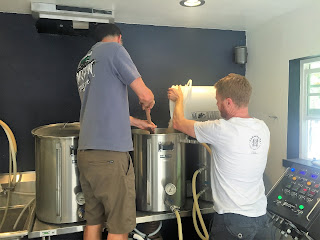
gallons of mash from cracked corn. This we were going to ferment, and later
distill. I had brought all the necessary fixings with us from Medford.
This has nothing to do with my enjoyment of the
work at the Curley School woodshop. I have homebrewed ales for several years. At
that time, I had become interested in distillation, and the creating of craft
whiskey. I brought along my six-gallon pot still. As a sideline to the
woodworking and home remodeling, we were going to create some Arizona
Moonshine.
A month ago, Chris and I ran the still on some
corn mash I had brewed. The still produced about three quarts of 120 proof,
clear shine. I soaked medium burnt oak chips in the alcohol. This gave the liquid
a nice tone, and it added a bit of barrel-aged character. After filtering out
the chips, I diluted the alcohol with water to make normal 80 proof, 40% ABV, strength
whiskey.
I experimented with flavor modifying the shine
a bit. I had bought some Maple extract. Adding a few milliliters of the extract
per pint volume of the whiskey created a fuller aftertaste, and it gave the shine
a richer scent. An ounce of the shine, washing a couple of ice cubes in a small
glass, is a pleasant way to watch the evening news.
Although Dave and Joy do not have a television
in their winter home, in Why. They could still enjoy a respite at the end of a
busy day. I had brought along my jug, and the shine was well received.
It had become the middle of the evening before
the temperature of the new mash was low enough to safely add the yeast starter.
We took a specific gravity (SG) reading of the mash to see how much sugar it
contained. The reading was too low to be able to produce a working amount of
alcohol. Something in the preparation process had gone wrong. We carried the cooled
container into the Arizona room, and we left it for the night.

I worried overnight about what may have caused such a low SG in the mash, and how we might benefit from all our hard work. It came to me that a quite common way to make whiskey strength alcohol is to brew a sugar mash. A sugar mash is made, for say a five-gallon brew, by adding ten pounds of sugar to the water. After all, sugar is what the yeast likes to eat. The sugar wash, however, doesn’t contain the nutrients required for the yeast to multiply. I had a packet of yeast nutrient, and the prescribed quantity was added to the wash.
The specific gravity reading of the sugar mash
said that we could end up with about 13% alcohol by volume (ABV). The work last
night had left the gallons of water loaded with the essence of corn. We stirred
in the yeast starter solution. The wash had been splash poured a few times
between two large buckets to aerate the liquid. Yeast needs oxygen to multiply.
The bucket was capped, and a bubbler was put in the lid’s center hole.
The next day, Monday, I called Dave to get a
report on how the brew was progressing. The report was that there was some
bubbling. Yea! We were on our way.
The Curley School artisan complex is run by
ISDA. This stands for some non-profit association. ISDA survives on grant funds
and rental remittances from craft people who rent the school’s converted
classroom apartments. The person primarily responsible for the ISDA operation
is Aaron.
Aaron has called a meeting of the woodshop
stewards for 1600 hrs. on Tuesday afternoon. It has been suggested that ISDA
has obtained grant money to be used to fund a shop manager. The shop has been
closed during the summer months because all the woodcraft stewards return home.
With a manager, the shop may be open year-round.
Michael has stressed strongly that he did not
want the woodshop to become “institutionalized”. He and others feel that among
the stewards, the shop operates very smoothly. Michael has called for a meeting
to be held one hour before that for Aaron. An agenda has been drawn up for our
meeting. We will cover business focused on the daily conduct of the shop. We
will also spend some minutes in counter-argument ideas to what Aaron, may or
may not propose.
The meeting went well. Aaron introduced us to
Rodney. Rodney is a woodcarver, and sculptor. He is currently employed by ISDA
as the GED instructor at the school. Rodney has managed school wood shops, and he
has taught many wood crafts. He is going to be the contact person for Aaron,
for the woodshop. Many topics were covered in the meeting. Everyone left comfortable
with the transactions.

During the day, I spent some time selecting scrap wood that I could use to create a tabletop for the Mesquite limb, patio table I am building for Dave and Joy. Several ¾” pieces of lumber were found. I squared the edges of each piece, so I could glue them side by side. I ran each piece through the planer, to clean them up. Lastly, I glued the edges, and I clamped them together.
After lunch, I used an electric hand planer to
correct any high spots that were left after the pieces were laminated. I sanded
the top surface of the new tabletop. I sketched a finished outline shape of the
top, and I used a saber saw to cut the shape. Finished with the final design, I
sanded the top to a nice finish. The next step will be to add an epoxy finish
to the top and the edges. The epoxy will protect the wood, while outdoors.
While inside the shop, we heard the distinct
sound of the diesel pickup driving into the lot. Joy parked the truck and she
climbed out. We all heard her squeal with excited joy as she recognized the limb
piece that had come from her backyard. She praised the fact that the table had
been completed. She considered it to be very special. She and I talked about
how it could be used on their patio. We agreed on two aspects of her new table;
it was completed and awaiting final curing of the epoxy, and that it was butt
ugly.
Saturday, January 16, Anne, and I did a quick
bit of shopping in the late afternoon. The southern Arizona sky had a slight,
cloudy haze to it. As the sun began to set, the sky started to redden. We
picked a route that would take us to the top of the hills to the west of the
city. We passed the huge open-pit copper mine, and we passed the turnoff to the
historic mining museum. The junction in the road drove us past a couple of the
more elegant homesites in Ajo. Alas, the drive found us once again at the
lower, city elevation. The sky had begun to darken. We had an interesting
cruise. However, we missed the full sunset.
Friday, I had turned a large mug from a 6”x6”
piece of redwood. I crafted a raised, top to bottom grip for the mug from a
piece of hardwood. I had sanded the mug smooth before I cut it from its tenon
base. The mug will hold about a quart of liquid. Now, all it needed was a
finish.
After breakfast, Saturday, I went to the shop.
I was there long enough to apply the first coat of Tung oil to the new mug. I
returned to the house, where I read into the afternoon.
We slept in on Sunday until 0730 hrs. Following
breakfast, I drove to the woodshop, where I applied a second coat of Tung oil
to the mug. The second coat would begin to add a shine to the wood.
This afternoon, we were planning to drive to Why.
I wanted to deliver the cut-limb table to Dave and Joy. I lifted the table into
the back of the pickup. To secure the table, I wrapped a tiedown cargo strap
around the neck of the limb-table base. The hooks on the strap secured beneath
the lip of the truck bed. When I ratcheted the strap tight, the table was
secure.
I called Dave, and he said they would be home
from church around 1330 hrs. After lunch, we drove to Why. The table was
presented. Dave and I sat in the shade of the warm afternoon while we caught
up. Dave received a phone call from his friend, and neighbor, Tom. Dave invited
Tom and Teresa to drive over for a visit.
All six of us were now enjoying the warmth of
the large cement patio. Tom and Teresa have a small dog, Izzy. Izzy is a close
friend of Dave and Joy’s dog, Sadie. The two dogs nosed around the patio and
they found things to entertain themselves. All of a sudden, the dogs started
barking. They dashed across the patio towards the entry gate at the north of
the yard. We saw what had attracted them.
A large coyote was crossing the yard. The two
small dogs were determined to give chase to the larger feral carnivore. Dog owners
jumped up and began calling out to the dogs.
Teresa rushed forward from her chair. When
passing the new table, she tripped on the extended non-leg limb. Teresa fell.
She caught herself by landing on her forearms. Anne and I helped Teresa to her
feet. She said she felt OK.
The dogs had obeyed the calls to return to the
patio. As they were scrambling back, the coyote stopped at the gate opening.
From there it stared back to the patio. This wild dog cousin was large. Had the
pups closed near enough to threaten its space, the coyote would have had at
least one of them for an early dinner.

I opened the woodshop Monday morning. I had laminated a couple of pieces of oak the other day. The piece was now ready to pass through the planer a couple of times. This would clean up both sides, and it would make the wood a bit thinner. There is an old rocker in the corner of the woodshop. Stored out of the way, it gracefully collected dust.
The rocker had one broken rocker sled. I had
taken the good sled off the chair. I would use this piece as a template on the
oak that I had just planed. I traced the good sled on the oak. Using the band
saw, I cut close to the line. It took a few minutes of machine sanding to clean
imperfections from both edges.
The new sled needed to have two leg holes
drilled into it. I clamped new and old together and I marked where the holes
would be. I matched the angle of the drill bit entry, and I created the new
mounting holes.
The legs are built into the bottom of the chair
at a bit of an angle. I set the back leg into its new sled hole. The front leg
required the use of a clamp to draw it about an eighth of an inch into its
hole. The chair rocked, once again. It will no doubt be taken to the Three
Nations Market for resale next Saturday.

Last year, I had made four legs for a chair to be used in the shop. I had been asked by Jay to make the legs long enough so that one could work at the table while sitting. All turned out fine. The chair and I parted at the end of the season, both in good shape.
When I arrived at the shop this year, I noticed
that the chair was stored in the corner, covered with dust. Its legs were all
splayed away from the seat. Insufficient glue was used when it was first
assembled. The other option was that someone had rocked in the chair. Its long
legs would not permit that.

I re-glued the legs into the seat bottom. I also re-glued the cross braces. Finished, I set it aside. I am still contemplating the addition of braces for the legs mounted at the bottom of the seat.
The last coat of Tung oil that I had put on the
redwood mug had dried. The second coat had added a bit of gloss to the sanded
finish. When I get it to the house, I will use a measuring cup to determine how
much it will hold. I am guessing that it will be able to carry about one quart
of fine ale.
From the limb-table, I had cut a couple of
inches off one leg. This was done to bring the top of the limb to horizontal. The
small piece of wood was perfect for lathe turning into a sipping glass. It is fun
to have the machinery available to be able to spontaneously create a “thing”.
Today, January 19th is Joy’s
birthday. Dave had invited us to Why for a birthday celebration dinner. The
schedule was for us to be at their home at 1600 hrs. I had nothing special
happening at the woodshop, so I left the shop at 1230.
After lunch, I drove to Olsen’s to buy a couple
of cheap paintbrushes. I also wanted to find a nice bottle of Merlot for tonight’s
dinner.

I bought three, 2 ½” brushes for the shop. The brushes will be used to apply an epoxy finish. There were a couple of old, scraggly brushes in the parts cabinet. I used one of them when I applied epoxy to the top of the limb table. Patrick used the second one when he spread an epoxy coating atop his new tabletop. Patrick’s tabletop will require fine sanding, and a second coat of epoxy.
On my way back to the house, I dropped the
brushes off at the shop. Anne had made a birthday cake for tonight’s dessert. As
a side dish for dinner, she prepared potato salad. We loaded everything into
the car. We were off to Why.
The barbeque was fired up. We were going to
have hamburgers as the main entrée for dinner. Potato and green salads, as well
as Bush’s baked beans, were the side dishes. Plus, a fine California Merlot.
We all voted to wait a while before we took on
the cake for dessert. With the table cleared, we were ready to play some
pinochle. It was the guys against the gals.
The guys were ahead on the scoreboard when a timeout
was called for some birthday cake. Candles were lighted, and Happy Birthday was
sung. The cake was delicious. We decided to end the game playing.
The ladies had a quilt group gathering tomorrow
morning. They wanted to spend a few minutes going over details about the quilt
class project that they would all have to complete.
Dave
reclined in his lounge chair, with Sadie asleep on his lap. I read some from a tabletop
magazine. I found difficulty with my eyes staying adjusted on the story’s small
print, so I rested them.

We brought with us a small flat-screen TV, along with the Apple TV control module from the TV room. With the module, all one needs to enjoy an evening program is a WiFi link. We have unlimited data on our iPhones. All we need to do is turn the iPhone into a Hot Spot, and program the Apple module to use it.
Some evenings, the iPhone/Apple combination has
worked well. On other evenings, the iPhone’s internet speed seemed to be in the
negative. We could receive nothing.
We also used iPhones to link our laptops to the
internet. Here, too, on some days the speed was too slow to be able to even
read the day’s mail. The dependency frustration was getting to us.
Anne checked with the local internet company to
find out what kinds of service we could get set up. For streaming services,
used for example when watching TV, a 6 Mbps service was recommended. The arrangement
was made for the technician to visit the house on inauguration day, between
1000 and 1300 hrs.
I came home for lunch on Wednesday. The
internet modem had been installed. I used the Apple module to tune into ABC
News Live. There were several talking heads on the air. The streaming was quick
and seamless. I think this will work OK.
Twice,
since our arrival, I have used the hoses to water the dying desert flora in the
yard. This has been a very dry winter. Sometimes, I think that weather science
is magic. Last week, the forecast for Ajo was cloudy on Tuesday, and rain on
Wednesday.
Tuesday woke up bright blue but late in the day
clouds started to cover the sky. Wednesday, Ajo, and the surrounding desert
received a downpour. It was exciting to step outside after the rain and to take
in the smell of the quenched scene.
Friday is my day as a shop steward.
Anne was off to tennis at 0830 hrs. I Unplugged the Club Car and climbed
aboard. The solenoid clicked, but the rig didn’t move. I suspected that I may
not have had it plugged in correctly. Today was going to be for, “These boots
are made for walking”.
I arrived at the shop door, and I
discovered that the key lock had been replaced with a Schlage keypad lock. A
man drove up in a pickup. He asked if I needed in. I learned that he was Bucky.
Bucky was the head maintenance man for the complex. Bucky gave me the
combination. I think that it was blind luck that Bucky happened to drive up just
as I had arrived.
Most of the morning was taken up
with assisting Patrick, and others. Mid-day, Cathy came into the shop. Last
year I had made a nightstand for her use in her RV. Cathy had designed the
stand, and she asked if I would build it. The stand turned out fine. Today,
Cathy came in to ask me to build an open-framed stand with a removable middle
shelf.
As she had before, Cathy had made
notes about the design of her new RV stand. She tried to explain the stand’s
design, but her notes were only translatable by her. As I had done last year, I
walked Cathy to the chalkboard. At the board, I drew sketches of my
interpretation of her notes. After a few corrections, I had the design chalked
out on the board.

Cathy had purchased 2”x2” lumber for me to use. We discussed the project for a few more minutes. She left me with her phone number, and then she drove away. Later in the afternoon, I got started cutting the required pieces. I decided that I would butt-join all the pieces, but I would glue into the ends of the 2”x2” s a 1/8” thick by 3” long veneer tenon. The width of the tenon would the width of the wood. This wide sliver of veneer would add tremendous strength to the butt joints.
I prepared a second coating batch of
epoxy for Patrick’s tabletop. I left him to apply the new mix. He ran low on
the spread ability of the epoxy. I made another batch for him. When Patrick had
finished brushing on the epoxy, I used the propane torch to quickly wand over
the tabletop. This eliminated the few air bubbles that were left behind from
the brush strokes. The epoxy was the last task of the day. We locked up, and I
went home.
Joy invited us to Saturday morning brunch. She
planned for us to be in Why by 1030 hrs. When we arrived, Joy was tending some
outdoor plants, and Dave was in the attic, above the new master bedroom shower.
Dave was sizing a 2”x4” spacer, through which
he would screw down into the top of the shower wall header. He had inserted a
wire into the attic to mark the center/end of the top plate. The 2”x4” brace
would keep the free end of the shower wall from sliding at the ceiling.
I met Dave at the attic opening and he handed
the marked 2”x4” for me to cut. Let me see. Is it measure once, and cut twice? Or
is it measure twice and cut once? He crawled back to the shower wall head to
find out that the brace was too long. It turned out that for this piece, it was
measure twice, and cut twice.
Dave returned to earth, and I helped him
measure and cut the two studs for the shower wall. The studs were plumbed and
screwed into place. The next step was to locate where the shower control module
would be located. As one came to the shower, Dave wanted to be able to reach
around the wall and turn the shower on. The module would be mounted at 48”
high.
The shower module would be mounted to a 2”x4”
backplate that was screwed between the first two studs. It turned out that the
2”x4” s 1 ½” thickness was going to be about 2/3” too thick. The showerhead
fixture would be mounted using a 2”x4” plate, also. Both pieces of wood would
be taken to the woodshop where they would be planed to the correct thickness.
The ladies had finished their quilting discussion.
Dave and I had done what we could do until we had visited the shop. We decided
to have Dave ride with us to Ajo. Joy would join us later for Anne’s special
beef stroganoff dinner. While Anne tended to the pre-dinner preparations and a
deserved rest, Dave and I drove to the Curley woodshop.
We had the shop to ourselves. The two special
backing boards for the shower wall were thinned. Dave then helped me assemble
the two wall sections of the RV stand for Cathy. Our work at the shop finished,
we returned to the house.

Dinner would be an hour or more away. I turned on the TV and tuned in the “Chuck” series. We both enjoyed the antics of Chuck and the faux agents. I think this series goes back to the ’60s.
Dinner was wonderful. Joy kept things
interesting with queries about the chronological dating of the books of the New
Testament. After dinner, we Googled, and we asked Wikipedia about the chronology.
Joy’s thoughts were pretty much spot on.
Wine glasses were freshened. It was time to
play some dominoes. When Anne and I play, we see who can be the first to break
200 points. We were well on our way. When we stopped, Anne led with 125 points.
Skye and Victoria had called earlier. They are
motoring Skye’s Mustang to Emmett to store the car in the barn. The folks need
to brief Skye on how to turn the home heat and water systems on. They also need
to call Kevin and have him prepare to pull his trailer out of the barn. Kevin
is a friend and a helper who stays in a travel trailer on the property. Kevin
and Dave have been remodeling the trailer. This is why it was in the barn.
It had been a busy, yet enjoyable day. We
shared two great meals, and we shared skills in getting things done. I had
noticed, when at the Why home, that the corn mash was bubbling once in about 22
seconds. We are expecting rain on Sunday and again on Monday. By the time
Tuesday rolls around, it will be sunny, and the mash will have completed its
fermentation. It should be right for creating some shine.
Anne plans for tennis each Monday morning. The
wind was blowing strong. Anne said that she wouldn’t be playing today. I backed
the Club Car away from its charging station at the garage, and I rode to the
woodshop. At the shop, I used a bungee cord to hold the bench seat vertical. If
it started to rain, this would keep the seat dryer.
I spent much of the morning sanding the RV
stand I was making for Cathy. I collected the fine sawdust from this work. The
2”x2” s I used to build the stand had typical rounded edges. The soft edges
caused a small gap appearance at the butt end junctions. In hindsight, I should
have run the boards through the planner to sharpen the edges.
With the sawdust, I mixed some glue. I used a
chisel to press the mixture into the cracks at some of the joints. Hopefully,
the mixture will create a satisfactory result. Waiting for the glue to dry is a
lot like watching grass grow. On to the next job.
Rodney, the new shop manager, wanted to have a
bulletin board posted on the wall near the entry door. It was decided that the
board should be 2’x3’ on its sides and have the sides about 3” deep. The walled
pinboard would have a plexiglass cover.
Construction of the box would be done with
1”x4” stock. I scrounged the wood racks for some nice pieces. None were found. There
were two short lengths of 2”x4” that looked clean enough. I ripped the wood on
the table saw to create the pieces I needed. With the edges cleaned up by the
edger, I was ready to assemble.

Last year, I made a jig for cutting ¼” wide box joints. A piece of stock is clamped vertically to the jig. The exposed length of the router bit is set to the thickness of the wood you are using. The jig is then slid slowly into the spinning bit. The cut slot just made is then placed over the ¼” peg. Doing so fixes the wood to receive the next slot, and so on.
With the
jig adjusted for the thickness of the wood that I had prepared for the sides of
the pinboard, I carefully cut fingers into the ends of the four sides of the
box. The joints fit together fine.
The top shelf of Cathy’s RV stand needs to have
a rim attached. The rim will keep items set on the top from sliding off while
moving. I ran two 2”x2” offcut pieces across the edger. I then ripped the two square
pieces in half, on the table saw. I cut two to the length, and I cut two to the
width of the top shelf. Then I cut fingers in each end, for finger joining the
top shelf rim. The cutting was done.
I finished each of the two ¾” plywood shelves
with 1/8” thick strips of pine glued to the edges. With the rim glued to the
top shelf, the next thing I needed to do was to add a couple of pieces of dowel
to each shelf. The dowels would peg into the shelf frame. This will prevent the
shelves from sliding when the RV is moving.
Two ½” dowel pegs were added to the front,
bottom edge of each shelf. They peg into the front frame by ½”. The top shelf
rim frame was sanded, and then it was glued to the top shelf. Cathy’s RV stand
is now complete.
The pinboard for outside the shop door has the
frame built, sanded, and ready for the addition of inside backing strips. Thin,
¾” wide strips of wood will be glued to the inside bottom of the frame. These
strips will hold-in the fiber pinboard. I am leaning toward mounting the
pinboard assembly horizontal on the wall. I would like to see a plexiglass
window cover that is hinged on the bottom. This will permit adding and deleting
pinboard items with the cover hanging out of the way.
I was surprised Thursday by Rodney. We had
chatted a few days earlier about how Desert Senita, the local health clinic,
did not provide COVID-19 vaccine shots to those who had not been patients. Anne
and I both qualify for 75+ age for vaccinations. I told Rodney that I should,
perhaps, break a finger so that I could become a patient.
Rodney came by the woodshop to tell me that he
had just heard on the news that Desert Senita was dropping the patient
requirement. He said that I needed to call the clinic and set an appointment.
I set aside what I had been working on, and I
placed a call to the clinic. The operator passed me to the office that handles
scheduling. The phone rang and rang. I got a message machine. I left my name
and my phone number. This was going to be another lost cause attempt.
Friday is my day as a shop steward. I arrived
and I opened the woodshop at 0930 hrs. I was working contently, by myself, when
I got a phone call. The call was from Anna, of the Desert Senita clinic. Wow. A
returned phone call.
Straight away in the conversation, Anna let me
know that Anne and I had an appointment at 1500 hrs. for our first shots. She
proceeded to collect information from me. I was told to arrive several minutes
early because the clinic would have a lot of “new patient” paperwork to fill
out.

I called Anne and I told her the good news. She would plan to pick me up from the shop at about 1430 hrs. The clock on the wall seemed to go into slow motion. It was a long time until the appointment.
Early to arrive, we were handed clipboards that
were loaded with paperwork. To receive the shots, we needed to document
ourselves as new patients. This took us the fifteen minutes we had before the
appointment time.
The nurse sat us down. She asked which
shoulder. From the refrigerator, the nurse brought away two syringes of the
Maderna vaccine. Each syringe had a small amount of liquid. I went first. The
nurse said, “on three”, and then she counted. I didn’t notice the poke in my
shoulder, and I didn’t have any sensation of an injected volume.
The nurse gave us each a shot record card as
well as a card that told us of the date and time of our second shot. That is
scheduled for 1500 hrs. on February 26th. She then led us to the 15-minute
waiting room. A doctor introduced himself and he gave us a “vaccination before-and-after”
briefing paper. When our time was up, the doctor said we could leave.
We both silently spent the evening reflecting
on our bodies. We wondered if we were having any reactions to the vaccine. None
were reported. All seems well.
Friday was filled with rain. Saturday was loaded
with sunshine. This was the day that I had committed to Dave and Joy when we
would distill the corn mash. First, we needed to get past breakfast.
Anne started a sourdough mix three days ago. Begin
with some quantity of flour and water at room temperature. There is yeast
present in the general environment. Yeast has been hanging around the flour
before it became grain. So, when you hydrate the flour you are creating an
environment in which the yeast can come out of a dormant state and one in which
they can begin multiplying. The yeast multiply. The mixture starts to expand. Some
of the mixture is discarded and is replaced with a new feeding of flour and
water. This re-feeding process continues until the container begins to take on
a sour scent. At this time, a chef can remove some of the mixture and use it
for cooking. Of course, what volume is used, is replaced with a new feeding.
Anne had removed some of her new sourdough mix
last night. She began the preparation for Saturday morning’s sourdough
pancakes. Her grandmother made sourdough biscuits for breakfast every morning. Anne
grew up with the tradition. But it is going to be a back-to-school event for
the chef of the house. The pancakes were very good; however, they were not
light and fluffy.
Now we can drive to Why to do the day’s
distillation. The specific gravity (S.G.) of the mash before fermentation was
1.090. The S.G. of the fermented mash is 0.990. The difference between before
and after is 0.1. Using a Proof Calculator, the finished mash contained 13.13%
ABV. This ABV figure means that we should have over ¾ gallon of ethanol in the six-gallon
volume of mash.
Now there is no way we are going to distill that
much pure ethanol. What we will get is a volume of distillate that is a mixture
of alcohol and water. With careful control of the pot’s column temperature, we
could likely get over a gallon of high-proof shine.
There is a period of waiting when the flame is
first applied to the kettle of the pot still. The progress of vapor creation is
monitored via a thermometer probe placed at the junction where rising vapors
cross over to the condensing coil. The mash is brought slowly up to a near-boiling
temperature. The thermometer rises ever so slowly, initially. Then, in the
blink of an eye, the probe reads a temperature well above ambient. This means
that hot vapors have warmed the length of the column and are ready to cross
over to the condenser.
Coldwater is pumped through a tightly wound
coil of ¼” copper tube. This coil is the condenser coil. It is placed in the
path of the rising vapors. The condensation process is done in a section of the
still’s column that is accessed by passing through a T-junction. The condensed
liquid then flows outside of the still, and not back down the main column to
the pot.
Methanol, acetaldehyde, acetone, and some other
nasty fermentation byproducts have lower vaporization temperatures than does
ethanol. This means that they can be removed within a temperature range that
does not contain ethanol. This faction is called the fore shot. The fore shot is
the contents of the distillate that vaporized and is condensed below 80 C. This
mixture of icky’s can be used for fingernail polish remover, or paint thinner,
but it must not be used for consumption.
The probe temperature had risen quickly to over
50 C. I turned the heat down. The probe temperature, and thus the vapor
temperature, rose slowly to the high 70’s C. Output from the condenser tube dripped
slowly. The temperature reached the low 80’s C. This was the beginning of the
Head range of the condensation. I moved the output tube to a new container.
There had been about a cupful of fore shot collected. I discarded the fore
shot.
The Heads is the faction that is collected
between the vapor temperatures of 80 – 90 C. The Heads will produce an output
that has a proof range of up to 170. It contains a lot of alcohol. The Heads
will also still contain some distillate components which are a little bit off. The
Heads can be blended later with the Hearts distillate to create a very tasteful
product.
The Hearts faction is lower in alcohol proof
than the Heads. However, as the name of this faction indicates, this is the
finest range of the distillation process. The Hearts faction happens between 90
C and 95 C. The proof output of the Heart faction may be around 120 proof.
The work involved in distilling is to be able
to control the temperature of the vapors at the thermometer probe. One wants to
pass through the Heads, and through the Hearts, temperature ranges as slowly as
possible. In simple terms, when a mixture in a solution depletes the lower vapor
temperature compound, then the temperature will rise to the vapor temperature
of the next lowest. So, as long as heat is being applied, and the temperature
is not rising, then the mixture is exuding a majority of the desired vapors. This
is why pure water boils at 100 C, and it stays at that temperature until it is
all gone. We know, however, that water will begin to steam at a lower
temperature. That is its vapor temperature.
Above 95 C is the faction called the Tails. The
Tails still contain a large amount of ethanol, but this faction also contains some
larger alcohols that begin to impart off-flavors and scents to the distillate. The
Tails and the early portion of the Heads are generally not used by producers in
their retail products. At the end of the distillation run, the remains in the
pot are saved for the next mash distillation. They are added because of the
volume of ethanol that remains.
Today’s four-hour still-fest netted one gallon
of 130 proof moonshine. The next thing that needed to be done is to dilute the
shine with distilled or reverse osmosis water. We want the final product to be
80 proof, or 40% ABV. A dilution ratio calculation determined that approximately
0.65 gallons of water needed to be added. I added water a few cups at a time. I
then took a S.G. reading to see what the impact was. It finally took over 10
cups of water to reach the 80 proof reading on the Alcoholometer.
Shine from the still doesn’t look like whiskey.
It is crystal clear. Commercial producers of whiskey typically store the
still’s output in fire-charred oak barrels. This process ages and adds color
and flavor texture to the product. This effect can be emulated to a degree by
adding medium charred oak chips to the shine. In a few days, the liquid will
acquire a light amber color. It will also begin to have a flavor that is biased
with a hint of woodiness. This is also the opportune time to create special
flavors in some or all of the output. For example, adding a small, measured amount
of Maple Extract to a given volume of the moonshine will enhance the color, and
it will add a very slight maple aftertaste.
Sunday morning Anne cooked eggs and pancakes
for breakfast. She used some of her sourdough for the pancakes. The pancakes
were a little lighter this morning. The meal was yummy.
It was sad. During breakfast, we ran out of strawberry
jam and maple syrup. I told Anne that I wanted to visit Olson’s store to look
for canning jars. I want the jars to use for the moonshine. Anne added bread to
the shopping list.
Olson’s had no jars, and they haven’t been able
to order any for some time. While there, I visited the hardware section of the
store. I found some small hinges and some hasps. These will be used to add a
couple of doors to the cupboards at the woodshop.
Home again, I looked at Amazon for half-pint
jars. It had them, and they included lids. I ordered a package that came with
two sets of 12ea. The half-pint size seemed convenient for the last run that I
made.
Sunday we were asked to assist Dave and Joy in
the transporting of an Isuzu Trooper from Ajo to Why. Why? Because their
friend, Ross, who lives near Casa Grande, purchased it. No one is sure why Ross
purchased the SUV. Thoughts are that because he had worked a long time as a car
salesman, he just had an urge to deal with a used car.

No matter. The two drove to the house at 1030 hrs. We followed them out to the home where the SUV was. We had a short visit with Joe, the purveyor of the rig. He described what he had recently done to improve the SUV’s state. He explained to Dave what needed attention with the car.
My mission was to drive the SUV to Why, where
it would be parked at Duncan’s home until Ross comes to pick it up. The SUV is
a 2001 model. It seemed to have a very quiet body, at highway speeds. And, it
had a half tank of gas. Our treat for this morning’s small effort was a cup of coffee
and a maple bar.
My afternoon was spent at the woodshop. There,
I assembled the frame for the woodshop’s outdoor sign. I had collected some cut
branches of local trees that I planned to use with the sign. The words, “Wood Shop”
would be ceramic letters made by the pottery shop. Surrounding the words would
be 1” tall slices of different species of local wood. There was significant
chop saw time spent creating the many slices of wood. By the close of the
shop’s day, I had glued all the cut pieces onto the sign’s backboard. They formed a mosaic that surrounded the words.
The next step with the outdoor sign is to add a
layer of mortar to the background. Jason had a nearly full bag of premix mortar
that he brought to the shop for the cause. I mixed the mortar to a thin state.
I needed to be able to pour the mix between all the wood pieces. The shop
didn’t have a container that had a spout to pour from. Wait a minute. What
about that coffee pot that nobody uses?
The mortar premix set quickly. I slid and shook
the sign to level the poured mix. It took five to six coffee pots full to bring
the background to the desired level. Things cleaned up quickly. The last step
in the sign’s makeup is to sprinkle clean sawdust over the wet mortar. The
sawdust might add a spirit of what working in the shop really means.
Rodney gave me the name and phone number of a
woman who wanted to build a couple of things. Her name is Lisa. She owns and
operates a pet service shop in Ajo. She told Rodney that she had many wood
pallets that she would like to donate to the woodshop.
I called Lisa on Thursday morning. She would
like us to build a container that would hold three rubbish bins. The spirit of
the container is to present a tidier appearance regarding her waste bins. Her
daughter has a pet snake. The snake is kept in a terrarium. She would like to
make a stand for the snake’s home.
I asked Lisa to text me a sketch, with the dimensions
of the rubbish container. Her daughter would text me some pictures of what she
would like her terrarium stand to look like.
The sketch I received from Lisa was crude. I
spent a few minutes redrawing what I thought she was trying to display. My
drawing was sent to Lisa, along with a few questions. I received a quick
response. Lisa liked my drawing, and she answered each of my questions
regarding the container’s potential use.
Lisa told me that she had several pickup loads
of pallets that she wanted to deliver. The pallet timber can be used to build
the container. The same material should be plenty strong enough to use for a
terrarium stand. It will be at least a week before the shop will see the first
load of pallets.
As promised, Lisa brought a load of pallets to
the woodshop on Thursday. Rodney was there to help me unload them. Some of the
pallets looked rough. Several had split and unusable boards. Lisa said she
would bring another load next week.
Friday is my day in the shop. I arrived early.
I wanted to begin taking apart the pallets. This is not a fun chore. The 1”x6”
boards are nailed to the 2”x4” frame pieces with spiral cut nails. The purpose of
the use of these special nails is to hinder their removal when a woodshop
wishes to recycle the timbers. Some may claim that the nail’s usage serves another
esoteric purpose.
I managed to disassemble one complete pallet.
In the process, I collected three mostly rotten 1”x6” pieces of wood. I was
able to extract only a dozen, or so, of the spiral nails. The wood was
recovered by beating the wood past the head of each nail. Using a wedge under
the wood, to pry the nails out only resulted in cracking the boards.
Lisa’s spirit of contributing these pallets to
the woodshop is certainly a nice gesture. However, we are not going to be able
to recover sufficient boards suitable for constructing the two projects that
Lisa wants. What that means is that the pallets Lisa brings to the shop will be
on our shoulders to dispose of. The remainder of her pallets need to be carted
directly to the Ajo dump. I will call Lisa on the first of the week to tell her
that we can not use the pallet wood.
On Wednesday, a woman stopped at the shop. She
has a writing chest that has damage to both rear legs. Her name is Susan. Susan
brought with her a plastic bag that contained wood pieces from one of the bad
legs. I told Susan that the shop could re-glue the wood to the leg, but not
without there being evidence of the repair. She desired to have a reliable and
stable chest. She wasn’t too concerned about how it looked.
I asked Susan to email me some photos of the
damaged legs. Which she did. It looked like the chest may have been drug on its
rear legs. This perhaps caused the wood to splinter. I told her that I would
arrange a pickup to use to collect the desk the first of the week.
Today is Valentine's Day, February 14th.
Today is also Jim Leroy’s birthday. We received some great news this past week.
Jim and Paula are flying to Phoenix on Wednesday morning, the 17th. They
made plans to rent a car and drive to Ajo in the afternoon. They have plans to
visit with us for a week.
Anne stopped in at the town’s Visitor Center.
There she collected some maps and ideas for daytime site seeing. We are in the
heart of the Sonoran Desert. That sounds bleak. But there is a great variety in
the topology of southern Arizona, and this adds visual relief during outback
excursions. The greater Ajo area has a lot of history. We are planning memorable
daytime activities during their visit.

Jim recently went through a bout with COVID-19. The illness laid him up for a couple of weeks. He has received a clean wellness report and he is ready to travel. Paula recently retired from a long career with Rogue Federal Credit Union. She had served the credit union for over 40 years. Paula was adored by her coworkers. They gave her a warm and wonderful send-off. She is ready to begin filling this new chapter of her life with change, and with some adventure.
Anne and I began clearing the spare bedroom,
aka, sewing room, and readying the room for our guests. We found ample space in
the main bedroom for the sewing table and the worktable. There are a queen-size
mattress and box-spring stored in the garage. Early this week I will solicit
the help of a woodshop coworker to aid me in moving the spare bed.
Thursday Anne drove to Casa Grande. She needed
to do some large store shopping, and she had to visit a jeweler to get her wristwatch
battery replaced. She also made arrangements to have lunch with her friend,
Deli. She returned from the busy day with lots of pantry supplies. She had the
cooler filled with food for the refrigerator. In the cooler were some New York
Strip steaks. She plans to provide Valentine's meal for the Ajo Duncan’s.
A phone visit with Joy set the time and place
for the Valentine feast at 1630 hrs., in Why. The plan is to arrive early and to
put potatoes in the oven, to get their baking time started. Dave is planning to
have a fire going in the Chiminea. He has plenty of scrap wood, from the
woodshop, and comfortable chairs in which we can enjoy warmth, wine, and a
visit while the desert air quickly cools with the setting sun.
Barbequed
steaks, baked potatoes, tossed green salad, and a glass of Merlot made this a scrumptious
early evening meal. We spoke of many things while we enjoyed the company of the
ones we loved the most. Exhausted, Anne and I found ourselves on the short
journey back to Ajo at 2000 hrs.
Monday morning, we both arose early. Today Anne
had a match with her tennis group. I had to finish the leg repair on Susan’s writing
desk. I whisked myself away on the Club Car to the woodshop. Anne met up with the
other three players at the public courts near the high school.

I came back from the shop at lunchtime. I had done
the most I could think of to repair the broken rear legs of the desk. The
pieces of the legs that Susan had saved glued into their original places. The
glue work would prevent the wood from splintering once again along the same
wood grain lines. However, they may splinter anew next to the repair sites. A
cap attached to the bottom of each leg would prevent splintering should the
desk be slid again on the floor.
Lacking suitable
caps, I decided to insert a dowel in each leg. The 3/8” dowel would be added an
inch up from the bottom of each leg. The dowels would be glued in and they
would be set perpendicular to the split grain. The appearance of the finished work
was not objectionable. I think that Susan will get long service with the
repairs that were done at the shop.
Anne reported that she had had a good day on
the courts. They had played for two hours. Each team had won a set, and she had
enjoyed that she had served and had volleyed well. Both of us took some time
out after lunch.

Paula and Jim were arriving for their visit on Wednesday afternoon. The second bedroom, aka sewing room, needed to be remodeled and cleaned up. The small table, the sewing machine table, and the lounging chair were all removed. The tables were moved to the main bedroom, and the chair was put into the living room. I swept up the dust bunnies and I wiped the floor with a damp mop. The room was ready for the spare bed.
The queen mattress and box springs were neatly
stored inside the garage/shed at the back corner of the yard. I had considered
asking one of the guys from the woodshop to assist me in carrying the bed to
the house. When I spoke to Anne about bringing in the bed, she volunteered to
help me. We struggled with finding good grips on the box spring. It was stop-and-go
to the back door. The potential big problem with the box spring was whether it
could be maneuvered around the quick couple of turns when entering through the
back door.
The box spring is 80” long. It would not make
it into the house if brought in the long way. On the back porch, we stood the
spring upright. The height of the box spring was about an inch shorter than the
doorways. We slid the unit past the washing machine, across the kitchen floor, through
the living room, and into the bedroom. We made it. Looking back, it was as if
the distances between right-angle turns on the pathway were designed such that
this procedure could be done.
Next, was the heavy, floppy mattress.
Thankfully, the mattress had grip straps built onto the long sides. They made
lifting the bulk a bit easier. Carrying the mattress meant that we had to hoist
it to shoulder height, one at each end. The mattress had no problem going into
the house lengthwise. Once on the floor, however, the mattress received the
same sliding perks that the box spring had. Yea. The hard work was done.
Jim and Paula enjoyed a direct flight between
Medford and Phoenix. They arrived early Wednesday morning in Phoenix. They drove
to the front gate of our Guest House Road Casa shortly after lunchtime. Anne
prepared lunch, and we ate at the table in the outside room. It was great to
see them and to catch up on family transactions since Christmas time.
One of the things the Leroy’s and the Duncan’s
did regularly in Medford was to get together to play pinochle. After lunch, the
decks were brought out. It was the guys against the gals. The victory was
usually equally split between the two teams. This welcome to the Ajo match was
taken by the ladies. Drats!
We had many sightseeing sorties planned, while
Jim and Paula were here. The first excursion was to the Ajo Historical Society
Museum. The museum occupies the old St. Catherine’s Indian Mission (at the end of Indian
Village Road), the museum houses many artifacts and mementos from Ajo’s past.
The displays include a complete blacksmith shop, a dentist’s office, and an
early print shop.
On the way to the mission, we stopped at a viewpoint that overlooked the
New Cornelia open pit mine. The presence
of the copper-bearing ore was discovered
by the Spaniards in 1750. Copper was first produced in modern times in 1917.
The roughly circular pit is one and a half miles across at its widest point,
and 1,100 feet deep at the center.

Although not generally regarded as a 'dam', the New Cornelia Mine Tailings is often cited as the largest dam structure in the United States with a volume of 7.4 billion cubic feet. The mine was shut down in 1983 due to low copper prices, and a worker dispute with the local union. Copper production from the mine totaled 6.304 billion pounds of copper, worth about US$20.8 billion at the 2010 copper price of $3.30/pound.
The next day we drove the 10 miles long “scenic loop” that starts in
downtown Ajo. The loop goes around the gigantic open-pit copper mine, up into
the mountains behind Ajo, and then back down the mountains into downtown Ajo. The
scenic loop goes mostly through BLM land. Anywhere BLM is an open-door
invitation for RV boondocking. The lop is considered the most primo boondocking
in the Pima County, Arizona desert region. For the trip today, the loop was a
great way to have an up-close look at the fauna of the Sonoran Desert. We made
a few stops to walk about and to examine closely some of the many cacti species.
True to its reputation, the loop had many boondockers nested on pads of gravel
that had been carved at one time as off-shoots of the unpaved loop road.
We drove one branch road off the main loop. This poorly maintained stretch
of gullied dirt took us past a graveyard. The graveyard was sited on a hilly
piece of desert. The yard appeared to be well maintained. It was filled with
white crosses that were being used in place of gravesite headstones. At the
crest of one hill was an open, roofed patio. The graveyard is a burial spot for
the local Indian people, the Tohono O'odham. The patio is used as a ceremonial
gathering spot for recently departed.

Jim is a golfer. He was naturally interested in having a look at the Ajo Country Club Golf Course. When he saw a road sign pointing the way to the course, he wanted to visit. I told him that because of its location, visiting the golf course would best be done as an afternoon drive.
The Ajo County Club is an oasis of green, surrounded by desert. It
has the Ajo Mountains to the south, Childs Mountain to the west, and an arroyo
cutting through the middle of the course. The golf course offers an abundance
of wildlife, including roadrunners, coyotes, and deer. This course boasts a
“classic” Arizona setting for golf.
An unusual feature of the country club is its location. Driving seven
miles north, on AZ 85, the club is found off Mead Road. The golf course opened
in 1956. The main club building was originally used as the mess hall for the
nearby, formally WWII Army Air Corp training field. The airfield is now the Ajo
Municipal Airport.
The club offers a full bar, restaurant, and banquet facilities. It also
has a recently developed full-service RV campground. We needed a break. We
masked up and went to the inside bar. Coming away with a couple of diet colas,
and two pints of draft beer, we found a table on the outside covered patio. The
afternoon was warm, with the sun to our backs.

Saturday’s visit was to the Organ Pipe Cactus National Monument. Located south of Why on Route 85, the monument was established to protect this unique cactus and to maintain the great southwestern Sonoran Desert. A visitors’ center, campground, and two scenic drives enhance the traveler's desert visit.
We drove to the visitor’s center. An open, tent topped desk was set up at
the front door. All normally scheduled Ranger talks and tours have been
canceled, due to the Covid-19 pandemic. Entry to the center’s gift shop was
limited to six people at a time. Lucky for us, however, was the fact that the use
of the restrooms was uncontrolled.
We drove one of the associated scenic routes to its end. There we parked
and enjoyed a short hike on a trail into a section of the monument’s outback. We
were brought up close to various cacti, including many of the Organ Pipe. Organ
Pipe cactus is unique in the U.S. to this region of Pima county, in Arizona.
The main feature of the pipe cactus is the many arms that grow up from a central
base.

Stenocereus thurberi, the organ pipe cactus is a species of cactus native to Mexico and is unique in the U.S. to this region of Pima county, in Arizona. This species is found in rocky deserts. Its English common name is derived from its resemblance to a pipe organ. It is locally known as pitaya dulce, Spanish for "sweet pitaya" or sweet cactus fruit. The organ pipe cactus is usually pollinated by bats. The fruit is about the size of a tennis ball. Beneath the fruit's spiny exterior is red flesh that has been described as tasting better than watermelon.
From Organ Pipe Monument it is five miles to
Lukeville, AZ. Lukeville, named after native Arizonan Frank Luke, a World War I
flying ace, is the last stopping point for supplies before entering Mexico. It
has a U.S. Customs & Border Protection inspection station as well as
several small shops and a gas station. At Lukeville is also the opportunity to
get a close-up look at the infamous border wall.
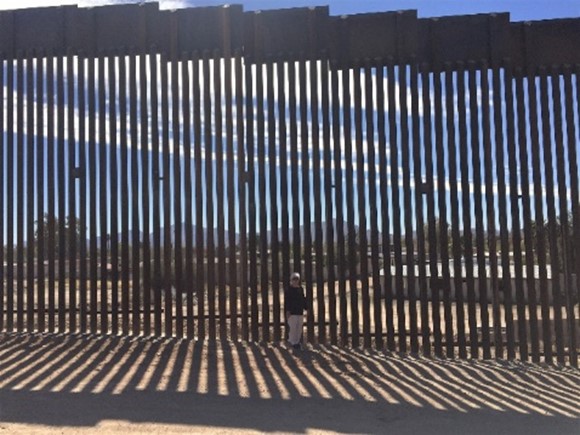
We drove a short distance along Puerto Blanco Drive, north of Lukeville. Puerto Blanco Drive took us west, and parallel to the border wall. After a short distance, we found a cutoff that led towards the wall. There were no roadside postings that said we were forbidden from driving close to the wall. We came to a cul-de-sac at the end of this dirt stretch. From there it was a short walk to the wall.
The visual of the wall was impressive. The wall is built from closely
spaced steel poles, known as bollards. The wall is 30 feet tall, as tall as a
two-story building. Looking west from Lukeville the wall snakes up the hills
and soon becomes out of sight. As we walked from the wall back to the pickup,
we were passed by a border patrol agent. He greeted us from his rolled-down
window.
At the Lukeville service station, we stopped for a lunch-time shopping
visit. We came away with a couple of bags of munchies, enough to stay off our
hunger until we arrived back home where we could fix a proper meal. It is 30
some miles between Lukeville and Ajo.
Once returned to the Guest House road home, the ladies prepared a
generous lunch. We enjoyed the meal at the table on the covered patio. A breeze
blew from the north through the screened walls. The table is set at the
southern wall. We were warmed by the sun at our backs as we ate. Mourning doves
were in and out of the backyard. Their non-stop cooing was determined to have
no sociological, pigeon purpose, if not to disturb an otherwise tranquil
afternoon. Following lunch, we brought out the cards and we enjoyed a couple of
rounds of pinochle. Our guy vs gal running total of wins had become five to
five.
After a short rest, Jim offered to help me deliver the repaired writing
desk to the owner’s home. I called Susan and set up a time. No one was at the
shop when we showed up. A quick load up of the desk into the rear of the pickup
and we were off.
Jim and I both found it difficult to carry the desk through the narrow
front gate at the front of Susan’s home. By the time we had hiked the furniture
up the steps at the front door, we were ready for a catch of our breaths. The
desk was replaced against the wall alongside the dining table. Susan was
pleased with the work that had been done to restore the rear legs. She offered
a $60 donation to the woodshop. Susan also gave the shop a new palm-held detail
sander and a bag of Velcro sanding pads. I thanked her, and we left.
The 2018 GMC Canyon had come with wonderfully functional windshield
wipers. During recent windshield dust cleansings, the driver’s side blade chose
to begin ripping apart. Ajo does not have much to offer for diverse shopping
experiences, but it does have a Napa Auto store. A few days earlier, I had
stopped at the store to buy a set of replacement blades.
The store was well stocked, but there was no attendant around. I waited a few minutes before I asked if there was anyone available to help me. To my surprise there immediately arose a young, and very tattooed woman. She may have been taking a siesta on the floor behind the counter. I told her of my need, and she selected two blades from a wiper display section. I thanked her, and I left.
Jim and I had tried to mount the new blades, but they had incorrect coupling points. After delivering Susan’s desk, I drove us to the Napa store. There I was going to exchange the blades. It was a few minutes past 1500 hrs. this Saturday. The Napa store had taken the afternoon off. I will return on Monday.
Sunday afternoon we are invited to Dave and Joy’s for dinner and a
visit. We stopped on the way home at Olsen’s store. I wanted to buy a bottle of
Merlot for the Sunday meal. I also needed to secure another box of Franzia
Merlot for our in-house use. Jim came into the store with me. At the checkout,
Jim beat me to the card reader. He graciously paid for our libation needs.
We had enjoyed a full and
satisfying Saturday. But it wasn’t over. Following a late dinner, we reset the
dining table and readied it for some pinochle. The running totals now read,
five to six in favor of the guys. We hit the sack after a couple of episodes of
“Chuck”, on the TV.

Anne has come down with a small case of sore throat and a sniffle. The sleep had gone well, up to 0500 hrs. when I awoke with a need to visit the porcelain pot. Returning to bed I got myself comfortable and I closed my eyes. Just then, Anne, while fast asleep, began to cough. I was not going to be able to regain sleep. I arose, put on my robe and I took the laptop to the dining table. With a morning cup of hot beverage, I sat down to work on this blog piece.
Paula joined me in the living room around 0800 hrs. I had prepared a pot
of coffee. She poured a cup and relaxed on the sofa with her iPhone. Anne joined
us a little later. Jim still slept.
Leroy’s are active in the Catholic Church. Immaculate Conception
Catholic Church is a stately, crisp white feature that is located on the main
road, directly across from the plaza. A first glance impression may be that of a
building somewhere in the tropics. Palm trees are bordering the church. Clad in
their Ajo, Sunday bests Jim and Paula left for the 1000 hrs. service.

Wow. That seemed quick. Leroy’s were back from the service in a little over one hour. They both had enjoyed the experience. The sermon had centered on the beginning of Lent. Anne had been busy, too. She was preparing bacon, sourdough pancakes, and a large cheese omelet. This sunny Sunday morning we ate our late breakfast at the patio table.
The feud goes on. The score stands at five to
six. We all shared in clearing the breakfast table. And then, the cards were
brought out. Anne had taped a blank paper to the living room wall. It had two columns:
women, and men. Paula was designated as the scorekeeper. At the end of the
morning's battle, the score read: women 6; men 9. Nice playing, Jim.

The Leroy’s had yet to visit the Duncan’s of Why. Anne and Joy have made arrangements for us to join them at 1630 hrs. for a Mexican dinner. We got ourselves together and we left Ajo a half-hour early. We were greeted eagerly at the front door. Friendly remembrance exchanges were made, and we were invited inside.
Dave asked Jim and me to follow him to the
patio. There, he had an evening warming fire going in the chimera. On the limb
table, he had some glasses placed next to a choice of three different wines. We
each selected, and then we pulled chairs nearer to the heat. Dave and Jim spent
a few minutes catching each other up on notables in their lives.
We stoked the fire, and then Dave took us
inside to have a look at the progress he has made with the new master bedroom/bathroom
construction. The water-in and the waste-out plumbing have all been put in
place. They are waiting for a shower control unit to arrive, and then the walls
can be finished.
It is a sunny afternoon. Why not take the
General out for a spin? Dave checked Jim out on how to operate his ATV (the
General). The General is a Rotax-powered working machine. Jim was going to take
Paula on a ride around the urban outback, that is Why. Powered up, and ready to
go, Dave guided Jim around the backyard trees. Jim was given instructions on
what turns to make when leaving the property. We could hear them enjoying the
bouncy jaunt. They came back grinning.
Outside again, the ladies joined us near the
chimera. Joy had prepared a plate of cream cheese with Cowboy Cactus Salsa.
This went with a bowl of tortilla chips. We all dug into the yummy combo. As
the afternoon merged into early evening, the breeze chilled. We abandoned our
outside visiting and we gathered inside.
Wednesday morning at 0930 hrs. we saw Jim and
Paula off. They were on their way to Phoenix International to catch their
afternoon flight back to Medford. They had enjoyed a direct, non-stop trip from
Medford to Phoenix. The return flight, however, is going to land first at
Seattle, take a 2-hour layover, and then onto Medford. They hope to be home by
2300 hrs.
The weeklong visit with Jim and Paula was a
special treat for Anne and me. We did some nice sightseeing, played many games
of pinochle, and we had wonderful visits. We will miss our dear friends, and we
will look forward to meeting with them again on the home front.
Last week, Lisa brought eight 2”x4” s to the
shop. These will be used for the construction of the frame for her rubbish bin holder.
I used full-sized ones to make the base. For the vertical ends, and for the lid,
I will rip the 2”x4”s in half. We are still awaiting the arrival of a few clean
pallets.
A broken spindle-back chair was dropped off. I
was selected to attempt the recovery. The chair seat had tightly woven wicker,
and the front edge of the surrounding wood had broken away. The wicker pulled
hard on the front and caused it to curl back. I found a way to clamp the front wood
back in place without damaging the wicker. Working with one corner at a time, I
glued and left it to cure overnight.

Besides the broken leading edge of the seat, the chair had a couple of broken leg cross rails. It must have gone through an abused time in its life. The holes for the cross dowels have been drilled ½” diameter. The dowels, however, are 5/8”. The ends have been turned to fit the holes in the legs. The dowels can all be replaced using ½” stock, or a larger dowel could be bought, and the plug ends can be turned down to fit. With the repairs, the once fine display days for the spindle-back have ended.
Jay
shared the shop with me on Friday. He held down the fort while I drove to Olsen’s
to buy a couple of lengths of 5/8” dowel. The lengths of the four cross braces
that needed replacing were short enough to mount on the lathe. I allowed ¾” at
each end to be reinserted in the chair legs. That length is how much I turned
down to ½”.
After completing the lathe work, I test-mounted
the legs and the cross braces. Everything seemed to fit together ok. I will do
the glue-up on my next visit.
A visitor, Ken, came into the shop with a
question. He has a 5” slice of a tree that he would like to have planed level. The
slice of wood is about four feet in diameter. Once the cut edges are flat, and
parallel, Ken would like to add some legs. This will be used as an outdoor
table. He is making it for his son.
Jay visited with Ken, and he told him that the
shop could do what he requested. A sled would need to be built for the router. The
sled would permit the router’s bit to be moved back and forth over the face of
the large wafer of wood. This would create a surface that is parallel with the top
of the workbench. Ken said that he would bring the wood to the shop on Monday.
Three weeks ago, Anne and I received our first
shot of the Covid-19 vaccine. This afternoon, at 1500 hrs. we have an appointment
to get our second shot. I closed the shop early. Anne and I arrived at the Desert
Senita Clinic a few minutes ahead of schedule. We were met outside the front
door by a nurse. She asked us a few questions, and then she took our
temperatures at our foreheads. Both of us passed the test and we were shown
inside the clinic.
One of the ladies behind the plexiglass at the
reception counter handed us clipboards and pens. What a relief. Today’s
paperwork was only one sheet. It asked for name, address, age, and phone
number. I suppose this homework was necessary to document any changes since our
last visit. Within a few minutes, a nurse came into the waiting room and she
called our names.
Desert Senita is very security conscious. Access
to anywhere beyond the reception waiting room was restricted to employees using
proximity cards to unlock the inner doors. We followed Nurse Paula to the immunization
suite. She seated us and then she took our temperatures. This time we got our
body heat read with an ear probe. Both of us were reading in the 98F range. We
were ready.
The nightly news program always leads with an
update regarding the pandemic. Of late, the news has been about the supplies of
vaccine. Naturally, no vaccine news story is complete unless it shows two or
three closeups of long needles being poked into someone’s shoulder. Visions of the
news program’s video were on both of our minds as Paula gave us the poke.
Nurse Paula directed us to the 15-minute,
post-shot waiting room. In the room, we visited with the attending doctor. The
doctor explained to us the reason there is often a day or two of second-shot body
discomfort. The symptoms can be very similar to those created by the virus. The
reason is that the body has created antibodies to defend against the intrusion
of additional mRNA. The immunization shot does not contain any actual virus.
The messenger RNA has been designed to create antibodies that will fight any
invading Corona-19 virus. The second shot increases the effectiveness of the
vaccine, as well as extending its active lifetime.
We ate dinner out this night. The Chu Chu Club
has meals each Friday. They alternate weekly between deep-fried fish and
chicken-fried steak. This week it will be steak for dinner. We watched the ABC
Nightly News and then we drove to the club. We were there at a few minutes past
1800 hrs.
The Chu Chu Club is a membership club. However,
you don’t need to be a member to eat the Friday dinners. American Citizens
Social Club is the official name of the club. The main member attraction is the
inexpensive bar tab. The building is divided in half. One half is the bar. It
has an adjoining social area and pool room. This is the member side. The other
half of the building features a large room with tables and chairs. Adjoining
this room is a small kitchen. This half of the building is used for the Friday
dinners, that are sponsored by the American Legion, and for large social
events, such as Saturday night dances.
We learned that the American Legion Auxiliary
in Ajo used the money earned at the Friday dinners to sponsor youth to Boy’s
State. The chef is a Legionnaire. He and his wife, who collects the $10 for
each meal, spent a few minutes telling us about their work with Boy’s State. They
are proud of the effect that the program has on youth who attend.

The chicken fried steak dinner was served in a large, partitioned Styrofoam container. The meal consists of two slabs of the hammered meat, a serving of corn, a serving of mashed potatoes, and a bun with two packets of butter. The meat and potatoes were swimming in heavy white gravy. The door into the bar is open to the diners. I bought a diet Coke for Anne and a class of Merlot for me.
The meal went quickly. We had finished eating
by 1830 hrs. We thanked the Legionnaire and his wife when we left. We
challenged each other to pinochle and dominos when we arrived at the house. Anne
bested me with the cards, but I came back on top with the tiles.
I spent a short time Saturday at the shop.
While there, I finished gluing up the spindle back chair. The new leg cross-rails
that I made needed to be stained. I located a small can of Red Oak stain on the
paint shelf. The color turned out to be an exact match for the chair. Glued and
stained. I left the chair for the weekend.

On Monday, my mission was to complete the construction of the three-bin container for Lisa. She had asked to have a hinged lid on the container. Jay and I talked about the hinged lid and we couldn’t figure out the possible reason for it. I texted Lisa and I asked her what the reason was for the lid. She responded that it would be just like her daughter to overfill a rubbish bin. Lisa would need to open the container to redistribute the trash. I reminded her that she had built in a foot of clearance for the top of the bins. That should be sufficient space to do any reshuffling. She agreed.
With the hinged lid eliminated, all I needed to
do was put a cover on the top of the container. I sorted a few boards that I had been able to
salvage from the pile of pallets. To clean them up, I ran them through the wood
planer. I attached several of the boards to the container. Space between the
boards would eliminate standing water.
The top, sides, and back of the container were
built. The bottom of the container was complete. The two sections would be
joined after they were delivered to Lisa. There was one more detail that needed
to be done. Lisa told me she had four cartwheels that she wanted to mount on
the bottom. I had prepared the corners of the base for the addition of the
wheel.
Rodney stopped by. I showed him the finished chair. He said that he regretted not having taken a picture of the chair when it had been dropped off at the shop. The before, and after were dramatic. I told him that the chair was ready to be sold. We agreed that the prices should be between $50 and $75. Rodney took a photo of the chair, to post in his on-line advertisement.
True to his promise, Ken brought in his 5” slab
of redwood. He and Jay carried the large piece of rough-cut wood into the shop
and set it on the workbench. Jay and I set into designing a router sled setup
that could be used to flatten the slab’s surfaces. By early afternoon we had
Ken making passes across the surface of the slab with the router. Slide the
sled the width of the router bit, clamp the sled to the rail, and make another
pass. The bit is ¾” wide. Ken was kept busy.

Ken worked on his rosewood until closing. He
was at the front door early Tuesday morning. He finished the first pass over
the slice. Jay set Ken up with a bit that was a bit longer for the second pass.
The new bit was ½” diameter. The smaller size meant that Ken would need to make
several more adjustments and passes during the second trimming.
The rosewood slice was leveled by late morning.
The next step was to do a bench and floor clean-up. The sled framing was
removed and put away. I briefed Ken on the use of the belt sander. Care needed
to be handled carefully to avoid accidental edge gouging.
The 80 grit paper quickly took away the router trace lines.
The belt sander was put away and the orbital sander with 220 grit was brought
off of the shelf. The orbital sander was able to be used to apply direct attention
to areas of scratching and to burn and discolored spots. The wood surface was
feeling good. The 220 grit was replaced with 350 grit. The finer grit began to
add a soft luster to the finish.

The slice of wood has a large crack, or check.
We discussed methods that could be used to arrest further possible extensions
of the crack. Jay wanted to purchase a bowtie template for his use. He felt
that a bowtie splice insert across the crack would prevent crack expansion. It
would also add an appealing wood color accent to the tabletop. Jay will pick up
a template kit when on his trip to Tuscan, tomorrow.
Once the bowtie splices are added, a final
sanding will be done. The last step in the new tabletop’s finish will be to
apply an epoxy coat. The epoxy will seal the wood and will protect the wood
from outdoor elements.
Bucky is the primary serviceman for the Curley
school complex. The bulletin board has been finished for a couple of weeks. Arron,
the director of the complex was told of the need to decide where the bulletin
board could be hung. Because the Curley complex is on the historic register,
hanging something on the outside of a prominent building could cause a problem.

It was a pleasant surprise when I came to the shop this morning. There is a handicap parking sign on the wall where we originally wished to have the board mounted. It turned out that the county government bureaucracy that would be involved to get the sign moved, should a request be submitted, was a task that Arron did not want to undertake. Bucky had mounted the board on the wall between the shop’s doors and the bathroom door. This may be a better place for the bulletin board. It will be seen by more people, than if it were on the handicap wall.
Rodney has offered the use of his office
printer. With the printer, a few well-presented section headings can be made
for the bulletin board; for example, Wanted and Sale. It would be great, too,
if there were a way to print photos of some of the pieces of work that have
been finished. That would present to the public an idea of what can be done in
the woodshop.
The landlord, Daniel Reed, stopped by the house.
He came to deliver the utility bill statements for last month’s usage. At that time,
we told him that we would be leaving Ajo in mid-March. Anne had prepared a half
month’s rent check for him.
During a shop visit with Rodney, he told me of
his visits to Sonoyta, Mexico. This is the town adjoining Lukeville. He and a
friend have visited Sonoyta several times while on backpacking trips. Rodney
told me of a couple of hotels that provided good service, and that have
excellent restaurants. This sounded like a great one-night getaway.
Rodney felt that Sonoyta was a safe town to
visit. During his visits, he and his friend had been approached by persons who
wanted to sell them drugs. He said that with a refusal, the sellers left them
alone. Perhaps the police tend to leave the drug pushers alone, so long as they
do not offend the tourist trade.
There is probably not very much to see with a day
trip to Sonoyta. I asked Anne to run the idea past Joy when they were on their drive
to Casa Grande. There, they were going to visit Deli, and all were going to get
pedicures and they were going to share lunch.
Several days later I got a phone call from
Dave. He told me what he had been working on at the house. He said that he and
Joy would like to drive to Puerto Penasco, aka Rocky Point, for a visit. They
were not interested in seeing more of Sonoyta.
Rocky Point is located on the northern shores of the Sea of Cortez on the small strip of land that joins the Baja California Peninsula with the rest of Mexico. Since the late 1990s, there has been a push to develop the area for tourism. It is now one of the most important tourist destinations in northern Mexico. Puerto Penasco is often called "Rocky Point" in English, and it has been nicknamed "Arizona’s Beach" as it is the closest beach to cities such as Phoenix, Tucson, and Yuma.
Two years ago, the four of us visited Rocky Point. We had stayed in a hotel that was located on the waterfront. This hotel did not have a sandy beach. When the tide was out, the shoreline was a rock. We had spent some time visiting the tourist strip. We also drove south of Puerto Penasco to a spot that had access to sandy beaches. As a departure from Ajo drew close, I did not want to revisit this tourist city. Anne and I decided to scrub any visit to Mexico this year.
On Friday, Rodney brought in a stubby, spindle
chair. The wood of the chair was in good physical shape. All the legs and
spindles needed to be re-glued. With that done, the chair would be solid as a
rock. However, the chair had been painted a light green. Besides being ugly,
the paint was chipping off. Everything needed to be stripped.
I began the rebuild process by removing the back
assembly as one piece. I then removed and labeled the legs and the cross
members. The base of the chair was now in pieces.

The legs and the cross pieces are all 1 ½” diameter, sculpted doweling. I wasn’t going to use any paint stripper. The easiest way to remove the paint would be to sand the parts while spinning them on the lathe. I tested this approach with three pieces. I used 80 grit sandpaper. The old paint came away quickly. Seven pieces are attached below the seat. There are five spindles on the back. They can all be sanded on the lathe. The seat and the back top will be sanded with the palm sander.
Monday was busy. I began the day sanding chair
spindles. That progressed well until Ken arrived. He had purchased a bowtie kit
this weekend, while on a trip to Phoenix. The package contained plexiglass
cutouts of different shapes to make splices for joining wood. It also had with
the package a router bit and bushings for making the cutout and then the
inserted piece.
I spent the rest of the morning helping Ken
with the splices. We made two splices across the fracture on his large redwood
slab. There should be no more cracking. I asked him to make the bowtie insert a
fraction taller than needed. This was so he could later sand down to the surface
of the redwood, assuring a smooth finish.
While at the wood store in Phoenix, Ken bought a
supply of epoxy. I asked him to make a putty using redwood sawdust and Titebond
glue. This putty would be used to fill the large crack from the bottom up to
within ¾” of the top surface. When this hardened, Ken would sand the surface at
the splices and then he would add epoxy to the crack. The epoxy for the crack
would have a light blue dye added. The dyed epoxy would add an accent to the
tabletop. When the accented epoxy has dried, Ken will sand it to the surface of
the wood. The next step will be to add a couple of coats of clear epoxy to the
entire surface.
Steve came to the shop with a “hurry up”
project. He had backed into his mailbox and that had broken the 4”x4” post.
Steve came to the shop with his mailbox. He wanted me to fashion a wood insert
for the bottom of the box. The insert would then be fastened to a new post.
I measured the recess on the bottom of the box.
A piece of wood was found in the scrap supply. I cut and attached the wood to
the box. While doing this, Steve had called Michael. Steve knew that Michael
had a 4”x4” post that could be used. Michael soon arrived with the post. We cut
the post to length, allowing for one foot of burial. I then mounted the box to
the post. Steve thought the completed work to be perfect. He dug into his pocket
and he pulled out $20 for a donation to the shop’s till. Two o’clock. It was
time for lunch.

When I carried Steve’s new mailbox assembly to his pickup, I discovered that he had brought along all his dining table chairs. There are five chairs. They all wiggle. Each of them needs to be taken apart and then re-glued. One of the chairs needs to have a cross-brace dowel replaced.
I began Wednesday morning by working on Steve’s
chairs. The chairs have seats that are woven. The weave isn’t done with cane.
It is more like tight strips of thick fabric. The weave joins in the middle of
the seat area and it creates four equal, triangular sections. The point of this
description is that the chairs cannot be taken apart without unraveling the seat
fabric. What I tried to do was to wiggle each chair to determine which joint(s)
were loose. When identified, I spread the legs to expose the cross-member tenons.
I then applied as much glue as I could to the tenon. I did this at each end of
each loose dowel cross member. The legs were then clamped to ensure that each
tenon was held tight.
Steve’s chairs are painted black. The paint has
been worn off of many of the cross members. The partial glue job helped stiffen
each chair. However, the best fix would be to completely take apart each chair,
sand each element bare, reassemble, repaint, and then reweave the seat. The key
is in knowledge of the weave.
The spindle chair has been sanded and then
reassembled. I selected from the paint shelf a walnut stain. I begged a pair of
latex gloves from Jay. Within a half-hour, the chair was looking very dark. I
will let it sit overnight.
Tomorrow I will give the chair a light sanding.
I will use 320 grit. I would like to achieve three things with the sanding.
First, I want to remove any raised fibers that have been created with the
staining. Second, I want to create a smooth surface upon which I will apply a
tung oil finish. And third, I would like to carefully lighten the hue of the
stain to give the appearance of wear in some areas, particularly on the seat.
This preparation shouldn’t take more than an hour.

When I began taking apart the pallets, I had
removed nails in many of the recovered 2”x ribs. Thinking that they may be reusable,
I stacked them near the wood bin. All the ribs had been used more than once.
They all had old plank nails that had been sawn off. The embedded nail bodies
made the wood unsafe to mill or to cut. I decided to just scrub them and cut
them into usable pieces of firewood.
Watching carefully to avoid nails, I cut several
ribs. A few of the ribs were oak. They would have been fine pieces, but for the
nails. From these cuts, I created four new bundles of firewood. I added them to
the growing stack that is piled against the outside wall.
Friday, I was up at 0630 hrs. There were no
shadows yet outside, but it was light enough to see clearly. As I began to
dress, I heard a neighbor’s dog barking. A glance out of the side window caught
a dog’s movement next door. I watched for a moment. Then, I saw two or more.
But they were not dogs. Javalinas had invaded.
As seen through the window, the Javalina were
about 15 feet away. They were busy nosing around in the gravel that was the
neighbor’s driveway. As I watched, all of a sudden, a couple of the animals
appeared just under the window. Some had come into our yard.
I disconnected my iPhone from its charging cable, and I took it to the window. The Javalina were just disappearing behind the edge of the outside patio. I carefully opened the back door. I stepped to the screened opening and from there I watched them in the back yard. There were ten animals that I counted. Four of them were large, and the rest seemed to be about half size. They tended to move together in a loose pack manner. There were a couple of large Javalina on the other side of the rear fence. Those animals moved back and forth on the graveled rear alley. There are no gaps in the fencing that would permit access to the alley. Those animals were separate.

The Javalina foraged the entire yard. A few of them disappeared behind the rear shed. Soon, all of them, in a stretched-out line, marched quickly past the side of the house. They exited onto Guest House Road. On to the next home.
Friday, the 12th of March, is my
last day as a Steward at the woodshop for 2021. This has been a busy couple of
months. I got to fix a lot of things, and I had the opportunity to assist
others with their projects. Old friendships have strengthened, and I am happy
to have made new friends.
It takes me over an hour, with interruptions,
to clean out my two lockers. Everything finds a place in one of the two lidded,
plastic containers, or the once laundry soap bucket, for small articles. Farewells
are said, and I am off.
Wait a minute. The Club Car stopped running. I
was about to drive it back to the house and return for the pickup. I asked Jay,
Michael, and Rodney to stay for a minute to help me load the Club Car onto the
trailer. I returned within five minutes towing the trailer. The four of us got
the cart loaded. The new trailer, with the drop-down tailgate, makes getting on
and off a breeze. Now, I can say goodbye.
Anne had dropped the truck off at the shop. Joy
and Dave followed her. Anne was going to Why with them. She is helping Joy cut
fabric for a quilt. I am to drive to Why after I lock up the shop. I left Jay
and Michael to lock up for the day. I headed for Why around 1600 hrs.
Dave doesn’t drink beer any longer, because he
believes it causes gout. I stopped at the house to off-load the trailer, and to
pick up a couple of tinnies. The overcast sky began to unload. My new wiper
blades took advantage of the heaven-sent to clean the windscreen.
Dave is currently adding a layer of ¼” cement
board to the walls of their new master bath shower. This board will be the base
for the finished tile surface. Construction is going slower than desired. Working
with sight problems is a handicap. I was quickly invited to assist with the
addition of a couple more precut sections of the cement board. With two people,
the panels went up quickly.
Joy and Anne had prepared dinner. The main
course was Grandma Duncan’s meatloaf. This recipe she had given to Anne. The main
dish shared the plates with baked potatoes and green salad. The lettuce in the
salad came from Joy’s front porch garden strip. All was well received.
Ajo is served by two electric power companies.
The south end of Ajo, where we are housed, is served by the Ajo Improvement
Company. Wednesday’s edition of the Ajo Copper News posted a warning that the
Improvement Company was going to make improvements from 1800 hrs. on Friday,
until 1000 hrs. on Saturday. Power was being shut off.
A few weeks back we experienced power
improvements. At that time, we bought some candles at the Dollar General. We
were ready for this evening of darkness in Ajo. And it was dark as we drove
into Ajo. There were a few places that had some lights glowing. Those were
homes that were owned by folks who knew how to deal with power improvements.
We used Anne’s Christmas flashlight to find our
way to the candles and to the soup cans that would serve as the candle bases. For
perhaps an hour, we worked on our iPads and computers. With no power, there was
no internet access. We were soon bored. I challenged Anne to pinochle by candlelight.
The game went well. I was wearing my sweater
and I was very concerned that as I leaned towards the light to read my cards,
that I would become enveloped in smoke. Rob was the champion. That concerned
Anne. She reached for the dominoes. In one round, she totaled over 90 points. She
was the clear victor. That was enough. Off to bed.
Saturday morning, we began collecting things
and packing the large plastic containers. I spent some time in the back of the
pickup. There was plenty of space. The container packing just needed to be well
organized. For the trip to Medford, I decided that I would carry a few more
things in the trailer. I found space under the Club Car for the still and a
couple of containers. With the tailgate locked, they would ride secure. Now,
there would be less overflow that needed to be carried on the back seat.
A few minutes past 0800 hrs. Monday morning,
March 15th, the Duncan’s left the Guest House Road home. Today’s
destination is Indio, in the Palm Desert. We had a full tank, snacks in a bag,
and a Clive Cussler story to listen to. As we approached the desert valley in
the latter part of the afternoon, we entered windy conditions. Clouds of dust
came from nowhere, heading somewhere. I received emergency weather warning for
high winds, on my iPhone.
We planned to stay at Fantasy Springs Casino,
in Indio. The truck was towing the Club Car on its trailer. This meant that I
needed to park far back in the parking lot. There I could take up five spaces
parking sideways. We walked to the casino front reception counter and we asked
about a room. There were no special discount packages that we could take
advantage of. The cost for one night would be over $180. That was a little out
of our budget. However, we were in the casino. Anne showed me to the bar, where
I ordered a draft. She marched away to take on a few bandits.
We linked up an hour later. Anne had played
several machines, and she was coming away a winner. I had finished my draft IPA
and I spent most of my time watching the wide variety of humanoids that walked
the carpet past my perch. We returned to the truck where Anne called the
neighboring Holiday Inn for a reservation. No worries. We were in. We had eaten
at one of the several lower standard quick service vendors on the second level of
the casino. The evening at the Inn was relaxed and early to bed.
Tuesday, our drive took us to a freeway exit
that had a Holiday Express. This night’s layover was located 60 miles south of
Sacramento. It had been a long drive. My legs were starting to run out of
comfortable bent positions. Dinner tonight was breakfast for both of us. We ate
at the Denny’s down the street.
We were on our last leg of the trip by eight o’clock
Wednesday morning. The trip map to Medford said that we had a little over a six-hour
drive. We should see the Rogue Valley by two this afternoon.
Everything was traveling well. That is until
the fuel gauge flashed the last leg warning. I suspect that I could have made
the final six miles to home. However, there was a Shell station at the North
Ashland exit. I pulled in and filled up. It left me with some good feelings.
First, I didn’t have to call Chris and ask him to bring me the five-gallon
jerry can of gas. Second, I arrived home with a full tank of gas. We had
traveled 4,205.4 miles on our winter trip to Ajo. Having a full tank made us
ready to go on our next Great Adventure.